

1. Triage – Your Fortnightly Rundown
Hi Pulse Readers - this week, we’re diving into:
a world-first live AI-assisted brain tumour surgery to protect a patient's sight,
what a 1,100-patient RCT found about AI for secondary prevention in heart disease,
and how to dictate concise, focused referrals with Ask Heidi.
2. Case Study – Your Fortnightly Practical
Video Source: Dr Karl Cole (MB ChB, FRNZCGP), Supercharge your GP Practice with Heidi Webinar in collaboration with Health Accelerator and Collaborative Aotearoa
Dictating Concise Referrals By Voice with Ask Heidi
Case Presentation: Last time, Dr Harry set up a lasting record for each patient, so their history and documents are there as context each time he sees them.
Today, he is seeing a woman who needs a rheumatology referral. She was assessed in Fiji and started on a medication that helped, but since returning her bloods have all been normal, and he is unsure of the next step.
In the past, he sometimes pasted the whole consult into the referral, and specialist colleagues find it hard to tell what was being asked. His referral system already holds the patient’s name and background, so what the specialist needs is the specific clinical question, kept short.
He wonders whether he can build the referral by voice and keep it that tight.
Approach: With Heidi Dictate, speak your request into Ask Heidi, then refine by voice until only the referral information you need remains.
Start from the finished consult note. Review the note as usual, so Ask Heidi works from an accurate source. Because the patient’s record is linked, her earlier notes and the specialist letter from Fiji already come in as context.
Dictate your request into the Ask Heidi bar. With the Heidi desktop app open, click into the Ask Heidi bar, hold your Dictate hotkey, and speak what you want. Dictate drops the text wherever your cursor sits, including this bar.
Prompt example: “Write a referral from primary care to a rheumatologist asking for an opinion on the next steps for this patient. She was assessed in Fiji and started on a medication that seemed to help, but her bloods here have all been normal. Keep it concise.”
Refine by voice until it is concise. Read what Ask Heidi returns, then dictate follow-up instructions in the same bar to shape it: “That is too long, cut it to the key points,” or “Focus on the fact that she can now walk no more than 10 metres.” Each round takes seconds.
Review, then paste it into your referral. Read the final version in full, then copy it into the referral field in your PMS or EHR.
Save a template for the common referrals. For the types of referrals you write regularly, have a template that summarises the structure concisely, in your library. Next time, you dictate only the specifics.
Outcomes: Dr Harry now speaks the request for the letter, tweaks it in a few passes, and pastes a short, clear referral into his system within minutes. Heidi Tasks also captured the referral as an action from the consult, and it is in his task list ready to send.
The referrals themselves are also answered more readily. When the clinical question is easy to find, the specialist can act on it, which matters most for patients like this one, whose care crosses borders and depends on us to pick up the thread quickly.
Disclaimer: Hendrix Health is the official New Zealand partner for Heidi Health.
3. The Pulse - Your Fortnightly Update
London Surgeons Perform the World's First Live AI-Assisted Brain Tumour Surgery to Protect a Patient's Sight
Surgeons at the National Hospital for Neurology and Neurosurgery (NHNN), part of University College London Hospitals (UCLH), have performed the world's first brain tumour operation supported by AI in real time. It removed an 11mm pituitary tumour that was costing a 48-year-old man his sight. The operation was part of an early UCL trial.
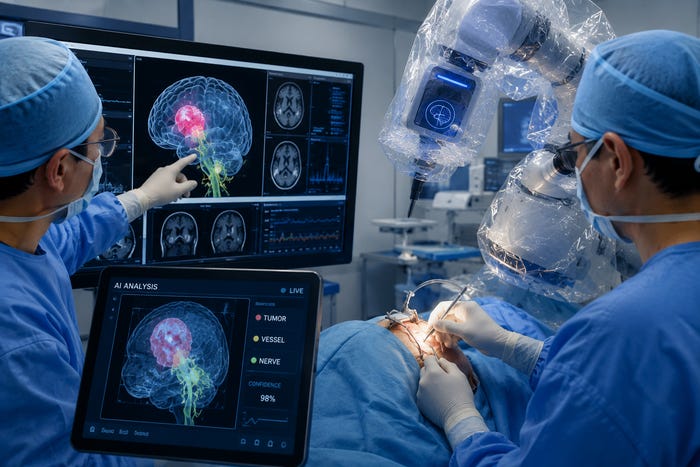
Image Source: Maeil Business
The pituitary gland sits at the base of the skull, wedged against the carotid arteries and optic nerves, where an error of a millimetre can cause blindness, stroke or death. Reaching the tumour with an endoscope through the nose, the surgeons operated while the AI read the live video feed, rather than pre-surgery scans, and marked hidden vessels and nerves on a second screen to show the safest zones.
Key Features:
Trained on hundreds of operations: It learned from hundreds of annotated pituitary surgery videos, more than most surgeons see in a career, to recognise critical anatomy and instruments
Works in real time: Unlike earlier surgical AI that reviews footage afterwards, it runs live on an NVIDIA Clara IGX platform that processes the video locally in theatre
Assistive, not autonomous: It marks danger zones and safe areas on a second screen while the surgeon keeps full control, working like facial recognition but for hidden anatomy
Early feasibility trial: The case is one of the first in a UCL and UCLH trial; the operation removed the tumour and preserved the patient’s vision, and a larger trial is planned
Implications for the Health System and Clinicians: This is an early sign of AI moving into the operating theatre, working with a surgeon, live. For New Zealand, where complex neurosurgery sits in a few major centres, a tool that acts as an expert second pair of eyes during high-risk procedures is worth watching, and its developers hope to extend it to other delicate operations. The caution is that this is a first-in-human case in an early feasibility trial, with regulatory approval pending and no outcomes data at scale. The jury is still out on whether it improves results across many surgeons and centres, without new risks from a mislabelled structure.
AI-Enhanced Secondary Prevention in Coronary Heart Disease: 1,100-Patient RCT
A randomised controlled trial in BMC Medicine tested whether an AI-enhanced smartphone system could improve secondary prevention after coronary heart disease. The single-centre, open-label trial at Fuwai Hospital in Beijing randomised 1,100 adults with confirmed CHD to the AIM-CHD system with usual care or usual care alone, over three months.
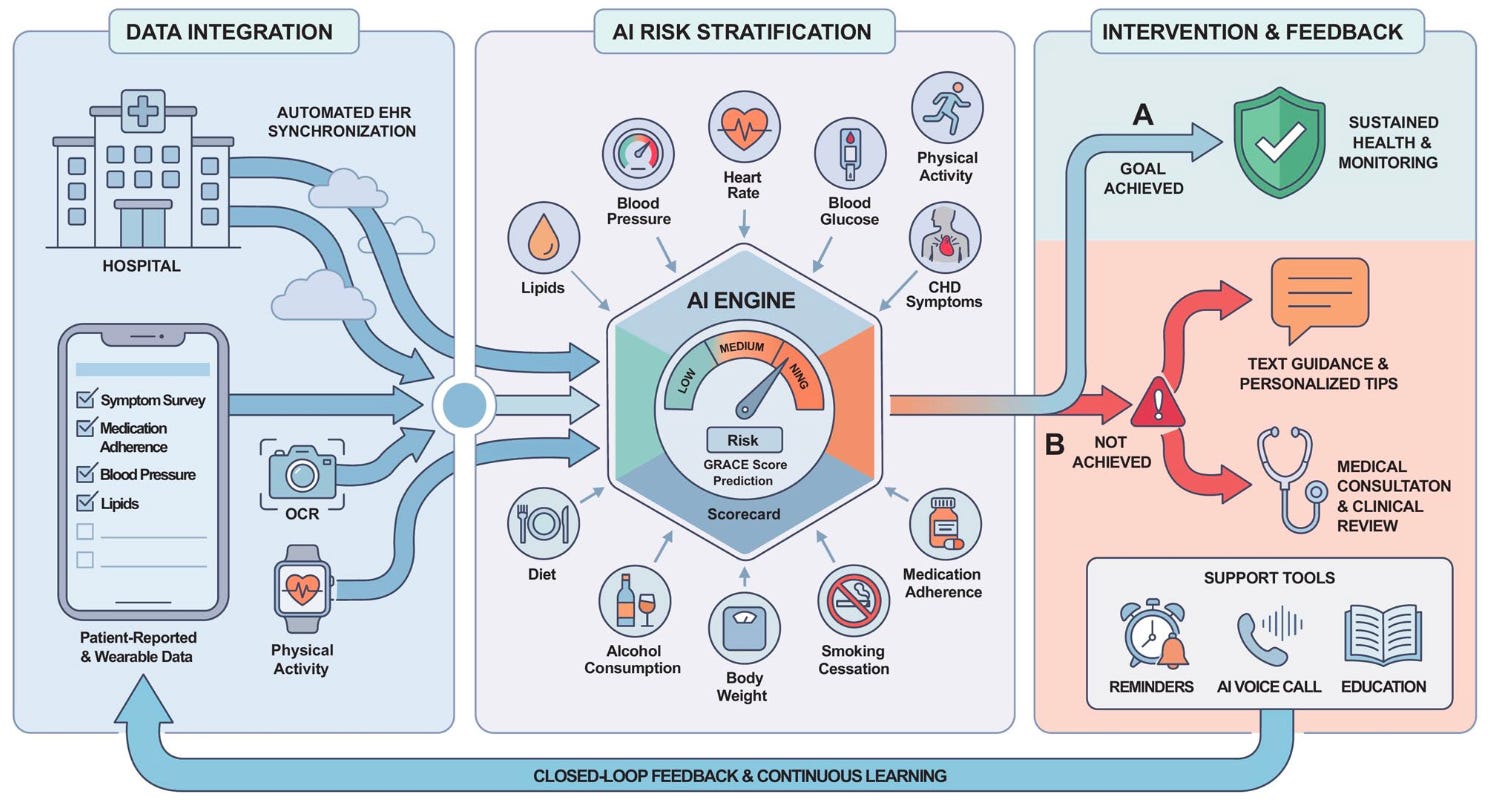
Image Source: BMC Medicine
After discharge, secondary prevention often drifts as follow-up fragments. AIM-CHD pulls in hospital and wearable data automatically, and has the patient photograph their follow-up blood-test reports. It then reads the results and checks them against guideline targets across 11 risk areas. When a target is missed, it sends alerts, education, and reminders, with treatment decisions left to the clinician. At baseline, cholesterol was already well controlled (LDL 2.03 mmol/L), leaving little room to improve.
Key Findings:
A small drop in cholesterol: At three months, LDL was slightly lower, 1.56 versus 1.65 mmol/L, a modest but significant reduction of 0.09 mmol/L (p=0.03).
More patients hit targets: More reached the LDL goal below 1.81 mmol/L (71% versus 64%; p=0.03) and the blood pressure goal below 130/80 mmHg (45% versus 35%; p=0.002).
No change elsewhere: The system did not shift blood sugar, weight, smoking, or medication-taking, and made no difference to a combined measure of heart attacks, strokes, readmissions, and deaths (3% versus 2%; p=0.69).
Low burden, but patchy engagement: Onboarding took about 10 minutes of nursing time, yet fewer than half (44.3%) sent in a follow-up cholesterol result for the app to act on.
Implications for Healthcare Systems:
In NZ, secondary prevention is daily primary-care work, and cardiovascular disease falls hardest on Māori and Pacific communities, so a low-burden phone-based system that nudges more patients to their targets is an appealing post-discharge model. But gains were modest and limited to surrogate measures. The participants are also mostly of Han Chinese ethnicity and the trial was run by the team that built the system. Longer follow-up ongoing and multicentre validation still needed.
Read the full study here.
4. Vitals – Quick Bytes
RACP Backs Human-in-the-Loop AI to Support More Personalised, Equitable Care
A recent position statement from the Royal Australasian College of Physicians (RACP) sets out how AI can be adopted safely and ethically in clinical practice. It points to gains already flowing through image-based disciplines such as radiology and pathology, alongside stronger diagnostic and therapeutic decision support and greater patient self-management. The RACP frames AI as a route towards a more personalised, equitable health system. To get there safely, the college backs an agile, human-in-the-loop approach that keeps clinical judgement central while building AI skills across training. This is supported by clinical governance, training, and data sovereignty for indigenous peoples. It cautions though, that AI should not be seen as a complete fix for the structural and funding constraints facing the health system.
EchoNext Gains First FDA Clearance to Flag Hidden Structural Heart Disease From a Standard ECG
EchoNext, a screening tool developed by Pathway Labs with NewYork-Presbyterian and Columbia, is the first AI cleared by the FDA to detect six forms of structural heart disease from a standard 12-lead ECG. It reads patterns in an ECG that are invisible to the human eye and flags patients who need a confirmatory echocardiogram. Trained on more than 700,000 ECG and echocardiogram pairs, it was validated across more than 20 hospitals and 500,000 patients in North America. On 3,200 ECGs it identified 77% of structural heart disease against 64% for cardiologists, and among nearly 85,000 people screened it roughly doubled the usual diagnostic yield. The tool triages rather than diagnoses and does not replace echocardiography or specialist judgement. Its performance in broader community settings is still to be proven at scale.
We’d love to hear your thoughts, so join the conversation by leaving a comment below:

Stay tuned for more insights in the next edition of The Pulse.
Have a great day & see you in two weeks!
Your Hendrix Health Team