

1. Triage – Your Fortnightly Rundown
Hi Pulse Readers - this week, we’re diving into:
India’s AI-powered E-ICU model revolutionising critical care delivery,
what 1.5 million Australian encounters reveal about AI virtual triage and ED demand shift,
and how you can “ask Heidi to do anything” for you.
2. Case Study – Your Fortnightly Practical
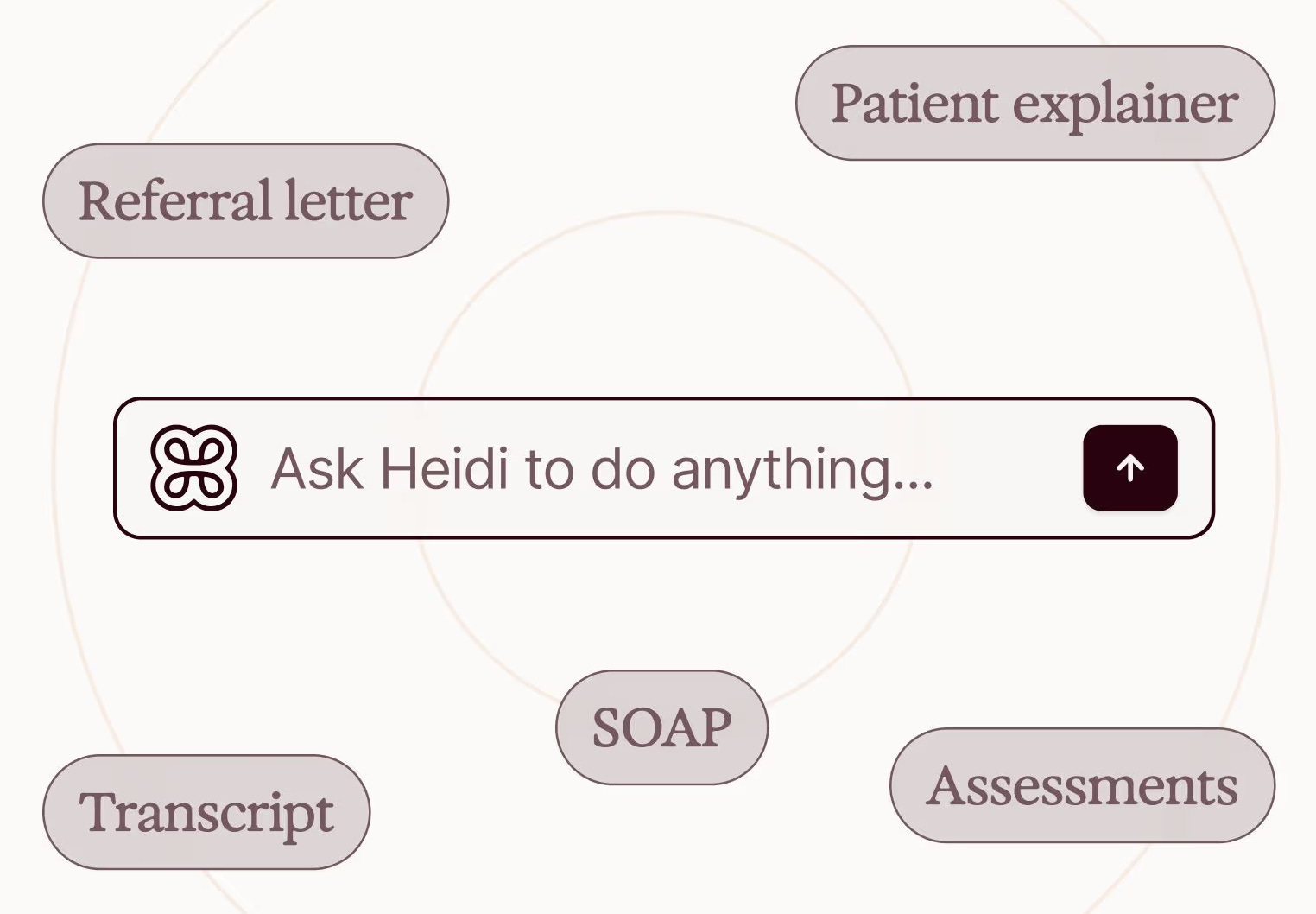
Image Source: Heidi Health
“Ask Heidi to Do Anything…”
Case Presentation: Last time, Dr Harry managed to build a dedicated ADHD assessment template to streamline his documentation. His consult notes became faster, more structured, and consistent across follow-ups.
Today, he met a young child whose presentation raised concerns, and he decided the child would benefit from a referral to a paediatrician for specialist input. However, he does not often write paediatric ADHD referral letters, and he has no pre-built template for this.
Dr Harry has already finished documenting the assessment with his ADHD template. But now he needs to draft a structured referral letter from scratch. He stays back an extra 30 minutes at the end of the day to do this.
He wonders whether Heidi can help with these kind of ad-hoc tasks – where no template exists and the structure is different from his standard notes.
Approach: Instead of writing from scratch or building a new template for a task you perform only occasionally, use Ask Heidi to repurpose the consult you have documented.
1. Finalise and review the consult note first
Complete and review your note as usual. Confirm accuracy of history, examination findings, medications, and impression.
Ask Heidi should work from an accurate, reviewed source document.
2. Ask Heidi to generate a specialist referral letter with a prompt
Simply type what you want to create into the Ask Heidi to do anything bar at the bottom of the screen, or tap the Ask Heidi button on mobile to open the text box and start typing.
Prompt example:
“Using this consult note, draft a referral letter to a paediatrician for ADHD assessment. Include relevant history, developmental details, family background, school concerns, previous interventions, current medications, risk assessment, and a clear clinical question. Write in formal New Zealand referral style.”
Note: A prompt is the instruction you give an artificial intelligence to tell it what to do. The clearer and more specific the instruction, the better the output.
3. Refine the output with follow up prompts in the same Ask Heidi chat box
Heidi analyses the existing consult note and context, and generates a structured referral letter in a new chat window. You may then tell Heidi to:
“Expand the developmental history and include psychosocial context.”
“Condense this to one page while retaining all clinically relevant information.”
This iterative prompting takes seconds, not another 20 minutes of rewriting. You will still need to review the final version for accuracy before copying and pasting it into your PMS or EHR referral system.
4. Apply the same workflow to other ad-hoc tasks
From the same consult note, you can also use Ask Heidi to:
Draft a school support letter
Generate a patient-friendly explanation of why referral is needed
Summarise the case for a MDT discussion / conference
Pull in medication information or add billing codes
Multiple potential outputs within seconds and no templates required.
Outcomes: By using Ask Heidi, Dr Harry no longer feels slowed down by work he does not have a template for or is less familiar with. Whether it is a paediatric referral, a school letter, or a one-off report, he can generate a refined output in minutes.
Instead of being disrupted by ad-hoc administrative tasks, he now has a flexible workflow that adapts to whatever the consult requires, without adding unnecessary time to the end of his day.
Disclaimer: Hendrix Health is the official New Zealand partner for Heidi Health.
3. The Pulse - Your Fortnightly Update
India Launches AI-Enabled E-ICU to Extend Private Specialist Critical Care to Public District Hospitals
An AI-enabled E-ICU Command Centre has been launched in Ghaziabad, India, linking a tertiary “base” command centre at a private hospital with the ICU at a public district hospital. The model is designed to strengthen critical care capacity by combining real-time, remote specialist oversight with AI-supported monitoring.

Image Source: IndiaMedToday
When a critically ill patient is admitted to the district hospital ICU, the system connects bedside monitors and the hospital information system to a centralised dashboard. AI-driven analytics then continuously assess patient data, support risk stratification, and generate early alerts for clinical deterioration. A central team of critical care specialists will be available 24/7 at the command centre to assist the on-ground medical teams with timely interventions and management.
This allows high-quality intensive care to be more accessible and affordable for economically weaker sections of society.
Key Features:
Continuous remote oversight: Round-the-clock specialist supervision from a central command centre supports on-site ICU teams.
Integrated clinical data: Bedside monitors and hospital systems feed into a unified dashboard for consolidated patient visibility.
AI-supported early warning: Algorithms assist with deterioration detection and risk stratification, aiming to enable earlier intervention.
District-level strengthening: The model focuses on expanding access to structured critical care support in non-tertiary settings.
Implications for the Health System and Clinicians:
For clinicians, the value proposition is the integration, earlier detection and access to immediate expert input when risk escalates. This results in more equitable healthcare delivery. For practice managers and health system leaders, this is infrastructure-level AI adoption. The technology is embedded within workflow, data, monitoring, escalation pathways, and governance, rather than deployed as an isolated tool.
The unanswered question remains outcomes. There is currently no published data on mortality, ICU length of stay, transfer rates, or adverse event reduction. The implementation architecture is clear, while the clinical impact still needs to be demonstrated.
AI Virtual Triage in Australia: What 1.5m Patient Encounters Show
A cross-sectional study in Mayo Clinic Proceedings: Digital Health evaluated Australia’s AI-based Virtual Triage and Care Referral (VTCR) system, deployed by Healthdirect Australia as a 24/7 digital front door to care.
Analysing 1,552,592 patient encounters between April 2023 and March 2025, the study examined whether the AI-driven symptom assessment improved alignment between patient care intent and recommended pathways. This includes self-care, GP, urgent care, virtual emergency, or in-person emergency services.

Image Source: Medical Republic
Key Findings:
Care alignment: The propotion of patients appropriately selecting lower-acuity, non-urgent care mroe than doubled, from 21% to 53%.
Uncertainty eliminated: Patients unsure what care to seek dropped from 43.2% to 0.2% – a 99.6% reduction.
Emergency department diversion: Intent to attend in-person ED fell from 37% to 25% as virtual pathways became available.
Virtual care uptake: Among those who initially planed to attend in-person ED, virtual emergency care rose from < 1% to 11%, with additional growth in telehealth and urgent care use.
System-level impact: If results seen in Victoria were replicated nationally, modelling suggests around 2,400 unnecessary non-urgent visits and 19,000 unnecessary ED visits could be avoided annually.
Implications for Healthcare Systems:
AI virtual triage demonstrates potential for improving care alignment, reducing patient uncertainty, and redirecting low-acuity demand away from emergency departments toward telehealth and urgent care pathways. The early signals are strong, but validation of actual service utilisation, cost savings, and hard clinical outcomes will be needed before large-scale adoption.
Read the full review here.
4. Vitals – Quick Bytes
NZ Government funds $4.6m for 10 AI-in-health research projects
The Health Research Council has awarded $4.6 million across ten artificial intelligence research projects aimed at transforming healthcare in Aotearoa. Funded initiatives span across AI-assisted stroke and radiology imaging, heart failure management tools, digital pathology for gastrointestinal cancers, postoperative monitoring, primary care diagnostic pilots, and ethical frameworks for responsible AI use. All projects are scheduled to run through to completion between late-2026 and late-2027. This investment reflects continued national focus on evaluating both technical accuracy and implementation, safety, and equity of AI within New Zealand’s health system. (hrc.govt.nz)
PRIMARY-AI: a propsed framework for judging whether AI helps or harms primary care
A Nature Medicine correspondence argues that AI is already being deployed at scale in primary care, but most evaluation still focuses on technical performance metrics rather than outcomes that actually matters in general practice, such as continuity, coordination, accessibility, and people-centered care. The authors propose PRIMARY-AI, an outcomes-based standards framework with a three-tier approach: safety and fairness, real-world effectiveness and reliability, and primary care-specific attributes including people-centeredness, coordination, and continuity. They plan to develop validated outcome sets and minimum evidence thresholds via a multi-stakeholder Delphi method beginning in 2026, with final standards targeted for October 2026.
We’d love to hear your thoughts, so join the conversation by leaving a comment below:

Stay tuned for more insights in the next edition of The Pulse.
Have a great day & see you in two weeks!
Your Hendrix Health Team