

1. Triage – Your Fortnightly Rundown
Hi Pulse Readers - this week, we’re diving into:
how a US hospital put the first FDA-authorised sepsis diagnostic into clinical use,
what a 295-patient RCT reveals about AI and gene diagnosis,
and how to keep each patient's history and documents together in Heidi.
2. Case Study – Your Fortnightly Practical
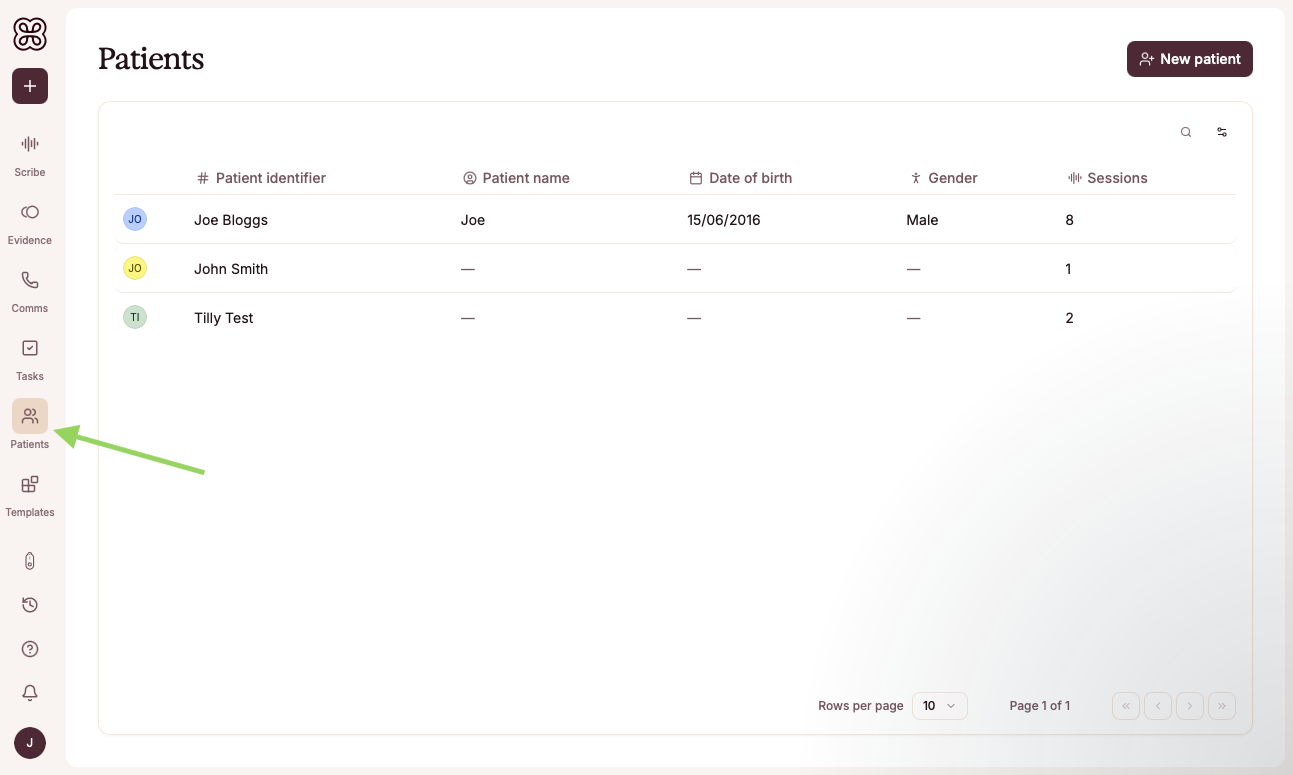
Image Source: Heidi Health
Keeping Each Patient's Clinical Context in One Place
Case Presentation: Dr Harry recently learned how to explain to patients what happens to their information inside Heidi.
Running a busy practice, many of his patients return. Some of the longer sessions such as the adult ADHD assessments tend to run across several appointments. At the start of each patient visit, Dr Harry re-enters the same history, medications and allergies into the context window, and hunts for the specialist letter he saved previously.
Dr Harry wonders whether Heidi can hold a lasting record for each patient, so their long term history and documents are simply there each time he sees them.
Approach: Open the Patients feature to add long-term/background information for each patient, then link sessions so the context carries from one visit to the next.
Open your Patient list
In the left-hand navigation menu, select Patients. This opens a searchable list of every patient you have created or linked a session to. Select a patient to see their details on the right: their linked session history, stored details, and any attached files. To add someone new, select New patient and complete their details.
Review and complete the stored fields
A patient record holds fields such as identifier, date of birth, past medical history, current medications, and allergies. Fill in what is useful. These persist across sessions and come in as context for each new session, so you do not re-enter them.
Important: Your PMS or EHR stays the source of truth for the patient record. The Heidi record holds the clinical context that lives within Heidi only.
Attach documents to the patient
In the patient's profile, select Files, then Attach files, to add background such as a referral letter or a specialist report. These stay with the patient and can be selected as context in any future session with them.
Start a linked session
Start a new session from within the patient, or at session start type the identifier and let Heidi match the record. Once the session is linked, the stored fields, the documents you choose, and up to three recent prior sessions automatically come in as context, so the note reflects continuity across visits.
Review what Heidi extracts afterwards
When Heidi detects new details in the transcript, such as a medication, an allergy, or a contact number, it offers to save them to the patient. You review each suggestion and accept or dismiss it. Nothing is saved without your confirmation.
Outcomes: Dr Harry now opens the patient and finds their record already in place at the start of every visit. Their history, documents, and recent sessions are available as context from the first minute.
For his ADHD follow-ups, where continuity across long, multi-visit assessments matters, the record carries the story forward. His notes reflect the full picture across visits, and he spends less time rebuilding context and more time with the patient and their whānau.
Disclaimer: Hendrix Health is the official New Zealand partner for Heidi Health.
3. The Pulse - Your Fortnightly Update
LifeBridge Health Puts the FDA-Authorised Sepsis ImmunoScore Into Clinical Use
Back in Issue 1, our Vitals review of AI in emergency-department sepsis care flagged tools like the Sepsis ImmunoScore. We noted sepsis AI still needed stronger validation and better workflow fit. That tool has now reached the bedside.
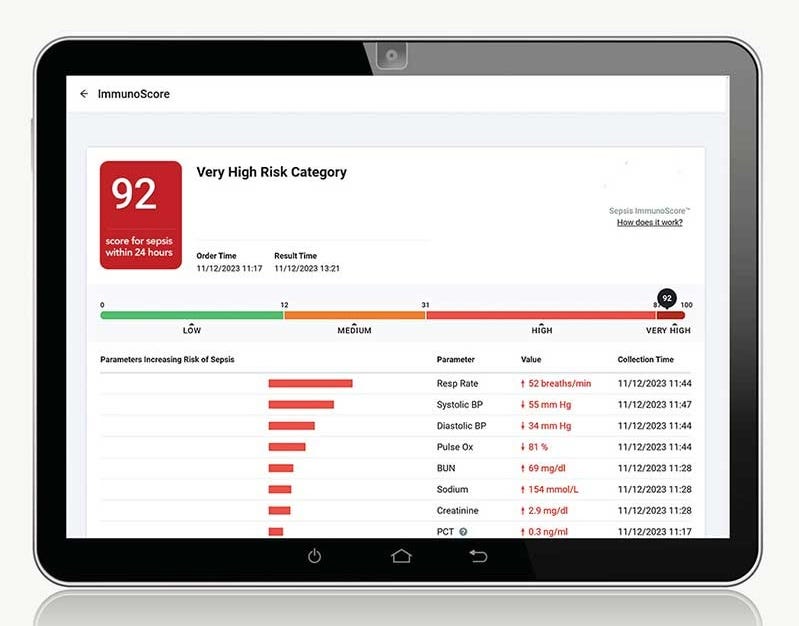
Image Source: Prenosis
LifeBridge Health’s Sinai Hospital of Baltimore has started using the Sepsis ImmunoScore, an AI diagnostic from Chicago-based Prenosis. It analyses 22 parameters of the immune response to flag sepsis, or its progression, within 24 hours. Results return in under an hour, inside the electronic medical record. Sinai went live with the tool in June and, by late July, had used it on 75 patients."
Sepsis is hard to diagnose. Uncertainty starts on arrival, blood cultures take days, and both unnecessary antibiotics and missed cases cause harm. In the US it affects at least 1.7 million adults a year.
Key Features:
A regulatory first: In 2024 the Sepsis ImmunoScore became the first software the FDA authorised to diagnose sepsis, cleared through its De Novo pathway
Peer-reviewed evidence: A study in NEJM AI found high accuracy for sepsis diagnosis and also predicted in-hospital mortality, length of stay, ICU admission, ventilation, and vasopressor use
Built to fit the workflow: LifeBridge’s emergency medicine chief says the tool seldom changes care in the ED itself; its value comes downstream, giving hospitalists more diagnostic certainty when they take over the patient
A precision-medicine approach: Prenosis treats sepsis as a syndrome with many biological subtypes, drawing on a biobank that, by company reports, covers 11 hospitals and more than 35,000 patients
What is being measured: Prenosis and LifeBridge are assessing the tool’s effect on sepsis-bundle (SEP-1) compliance, length of stay, in-hospital mortality, and 30-day readmission
Implications for the Health System and Clinicians: This is an example of AI moving from research into routine acute care. Sepsis carries high mortality and depends on early recognition. An easy-to-use tool that improves diagnostic certainty matches a familiar pressure in New Zealand's emergency departments. Prenosis plans to extend it to pneumonia, heart failure, and kidney injury, and LifeBridge to its other hospitals. Caveat being that it is still an early, single-site rollout with no outcome data yet. Whether sharper diagnosis improves the outcomes that matter is only now being measured.
Pointing to the Faulty Gene in Inherited Retinal Disease: What a 295-Patient RCT Shows
A randomised controlled trial in Nature Medicine tested whether an AI decision support tool, Retina4IRD, could help specialists predict the genetic cause of inherited retinal disease (IRD) before genetic testing. It compared specialists using the tool against specialists working alone across seven centres in China.
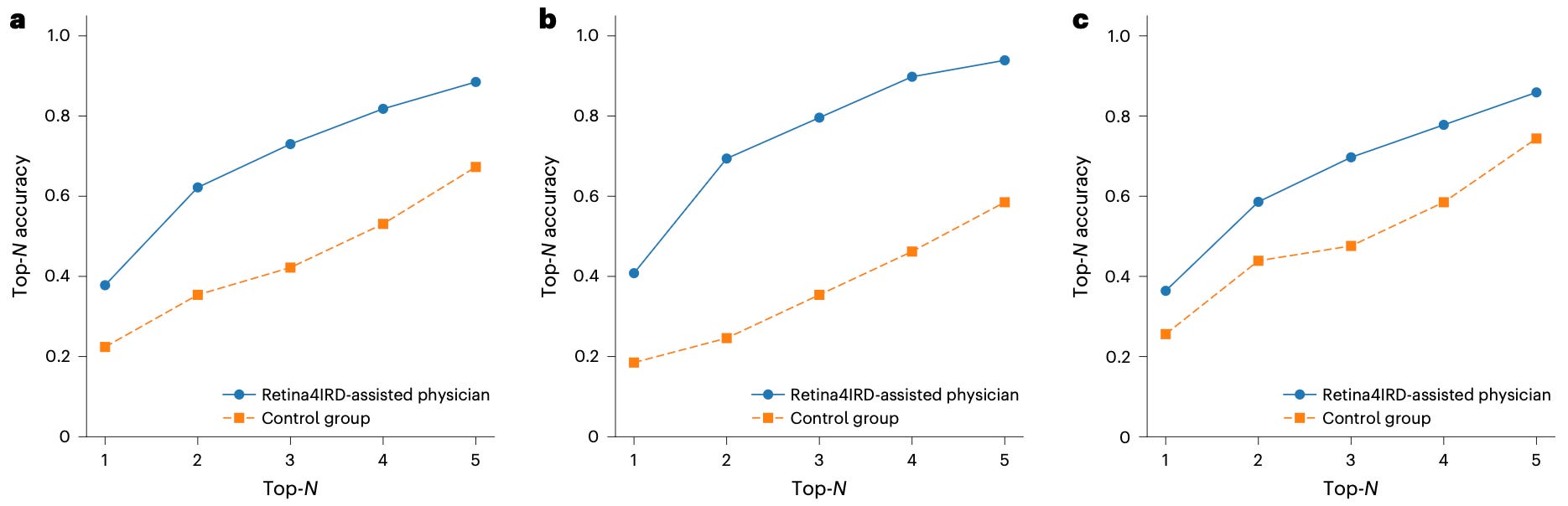
Image Source: Nature Medicine
Retina4IRD reads ordinary retinal photographs and scans alongside basic clinical details, then gives the specialist a shortlist of the genes most likely at fault. Even experienced specialists find these patterns hard to read by eye. It focuses on the treatable subtypes that make up about 60% of IRD cases. In the trial, 300 patients took part, and predictions were scored against genetic sequencing results, available for 295 patients.
Key Findings:
Found the right gene more often: With the tool, the correct gene was in the specialist’s top five ranking, 88.5% of the time, against 67.3% alone (P<0.001).
Better at the harder calls: The top pick was right 37.8% with the tool, up from 22.4%, and the top four covered 81.8%, up from 53.1%.
The lift came from the AI: The same specialists scored 68.2% before seeing the tool’s output and 88.5% after, close to the 67.3% in the control group.
Better plans, no harm: In an extra, exploratory analysis, management plans scored higher with the tool (37.7 versus 28.5, P<0.001), with no harm to patients.
Implications for Healthcare Systems:
Inherited retinal disease is a leading cause of blindness in children, and gene therapies make an early diagnosis matter. This is rare RCT-grade evidence that AI can lift even expert diagnostic accuracy, with scans most eye clinics already have. For New Zealand, where genetic-ophthalmology expertise sits in a few centres, pointing to the right gene sooner is worth watching. However, it guides testing rather than replacing it; the trial ran only in China, so multinational trials are the next test.
Read the full study here.
4. Vitals – Quick Bytes
New Zealand's GastroTriage Uses AI to Triage Colonoscopy Referrals
GastroTriage is an AI-assisted decision-support tool built in New Zealand to help specialists triage colonoscopy referrals, where endoscopy demand is high and free-text referrals must be read against several guidelines. Developed by Dr Jay Gong and Dr Henry Wei with Health New Zealand and the University of Auckland, it uses a large language model to read a referral against Ministry of Health criteria, return a recommended priority, flag anything missing or conflicting, and leave the final decision to the specialist. In an early evaluation of 100 referrals it matched a blinded consultant 70.1% of the time, against 58.0% agreement between clinicians themselves. A larger validation study of 600 referrals, half from Māori and Pacific patients, will build a specialist-consensus standard before any clinical use.
First Fully AI-Discovered Drug Reaches Phase III, with its Phase 1 Trialled in Aotearoa
A Phase 1 trial of 78 healthy volunteers in New Zealand was part of the early testing of rentosertib, now the first medicine with both an AI-discovered target and an AI-designed molecule to reach Phase III. Developed on Insilico Medicine's generative AI platform, the oral drug inhibits TNIK, a kinase implicated in fibrosis, for idiopathic pulmonary fibrosis. This is a progressive and often fatal lung-scarring disease. In an earlier Phase IIa trial of 71 patients in China, published in Nature Medicine and focused mainly on safety, the 60 mg daily dose improved forced vital capacity by a mean of 98.4 mL at 12 weeks, against a 20.3 mL decline on placebo. The Phase III trial will enrol 320 patients across 47 centres in China over 52 weeks, and the drug remains investigational and unapproved.
We’d love to hear your thoughts, so join the conversation by leaving a comment below:

Stay tuned for more insights in the next edition of The Pulse.
Have a great day & see you in two weeks!
Your Hendrix Health Team