

1. Triage – Your Fortnightly Rundown
Hi Pulse Readers - this week, we’re diving into:
how a South Australian home care provider use AI to cut morning rescheduling time,
what a 9,700-patient Kenyan RCT reveals about generative AI decision support in primary care,
and how to speak text into any application with Heidi Dictate.
2. Case Study – Your Fortnightly Practical
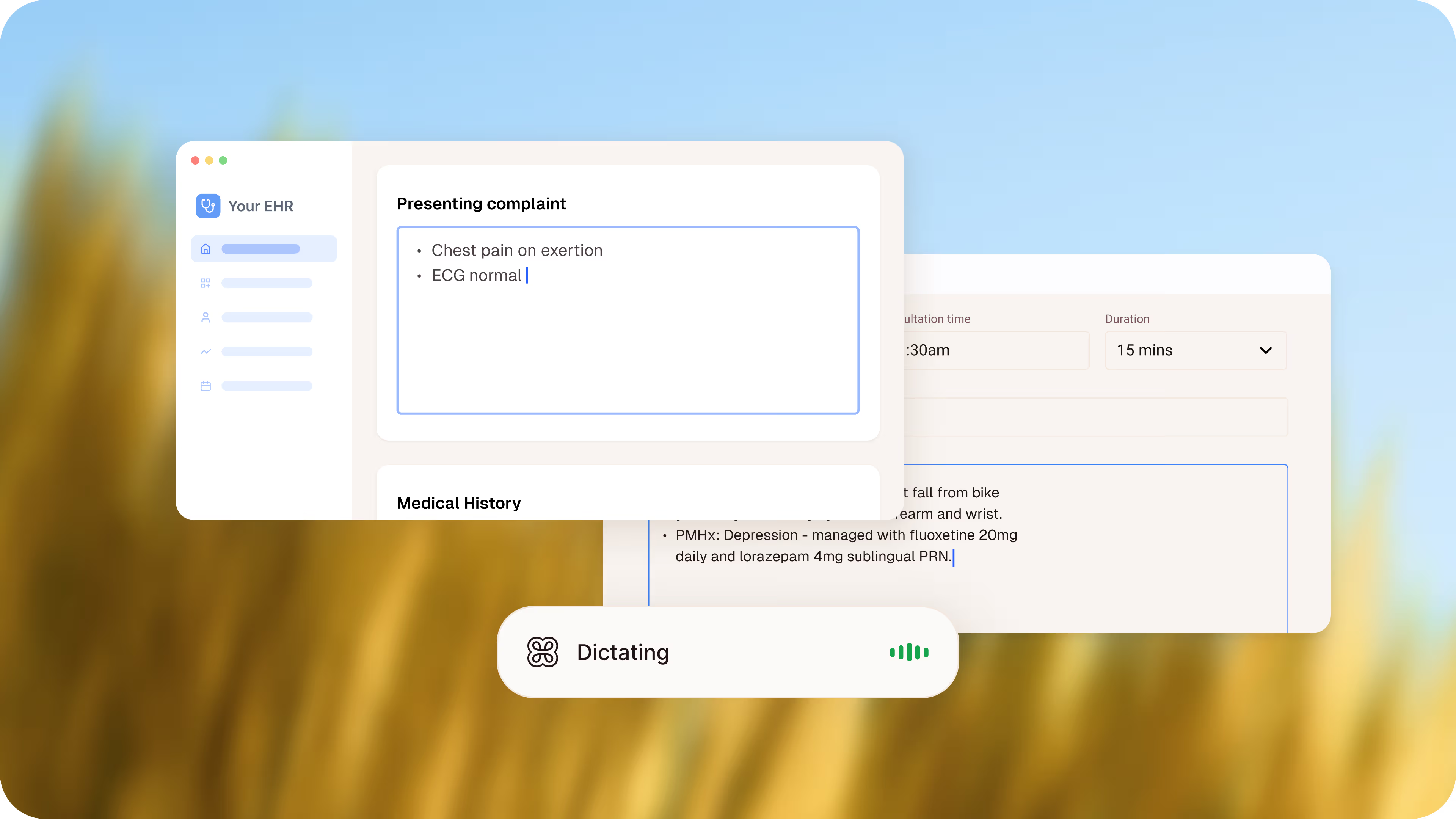
Image Source: Heidi Health
Type Anywhere with Your Voice
Case Presentation: Last time, the practice set up an agent to answer routine patient calls at the front desk.
This fortnight, the friction is back in Dr Harry's own desk: the typing itself. Between consultations, he types in detailed prompts for Heidi Evidence and Ask Heidi, but also replies to a colleague's email, and fills the free-text boxes on an insurer form. None of it is a full consult note, so Heidi Scribe is not the tool, and he is at the keyboard for small jobs all day.
He talks quickly, types slowly, and wonders whether Heidi can let him speak text straight into these other applications, the same way he dictates a note.
Approach: Use Heidi Dictate to speak text into anywhere on your computer, whether it’s Microsoft Word or your email, with one hotkey.
Leave the desktop app open and grant permissions
Dictate types into other applications only when the Heidi desktop app is open. If you use Heidi through a web browser instead, it works inside Heidi only. Install or update the desktop app, then grant microphone access.
Turn on Dictate and set your hotkey
Head over to Settings, under Defaults, scroll down to Dictate. The default hotkey is the right-hand Ctrl key on Windows, or the fn key on a Mac. Change it under Shortcut if it clashes with another key.
Note: Heidi Dictate is built into the desktop app, and Basic Dictate is free for every Heidi user. It needs an internet connection and does not run offline.
Then press and hold to speak
Click into any text field, press and hold the hotkey, speak, then release to drop the text in. For longer pieces, double tap the hotkey to dictate hands free, then tap again to stop.
Speak shorthand and commands as you go
Dictate expands the snippets you already use in Heidi, so a short trigger such as "ros" drops in a full review of systems, and you can even add personalised commands or snippets by pressing the View history button under Dictate. Built for medical-grade use, it handles the drug names and clinical terms that standard voice-to-text often mishears.Use the same hotkey across your day
The same hotkey works in your PMS, your email, a patient message, or the Ask Heidi bar, and you can also adjust the output tone for each usecase. Dictate supports more than 90 languages, so Dr Harry can set his dictation language to English or Cantonese.
Outcomes: Dr Harry can now speak his text straight into whatever screen he is working in. The sore hands ease, and because Dictate works the same way everywhere, one habit - one button, carries across his whole desktop. He finishes the day with less admin behind him and more time for the people in front of him.
Disclaimer: Hendrix Health is the official New Zealand partner for Heidi Health.
3. The Pulse - Your Fortnightly Update
Home Care Provider ECH Cuts Morning Rescheduling Time with an AI Rostering Agent
ECH, a home care provider in South Australia, has deployed an AI scheduling agent called Schedtris to manage last-minute changes to its rosters. Built by Gadali, an Indigenous-led technology company, the tool went live in March 2026 and now covers a client base of roughly 4,500 people, handling around 20 disruptions a day.

Image Source: iStock.com/hirun
When a care worker takes unplanned leave, Schedtris makes the shift vacant and searches for a replacement. It reads live workforce, skills, and availability data, grades each candidate’s suitability with a percentage score, and presents a shortlist. The final decision stays with the human scheduler.
Rostering in home care is a live optimisation problem. The pressure peaks in the morning rush, when a single absence can unravel a run of visits that must be rebuilt before carers set out.
Key Features:
Operational impact: Reported morning rescheduling time has fallen by 50%, recovering around 15 hours of scheduling capacity a week. The average time to handle a vacancy dropped from about 8 minutes to under 4, and the disruption window from two hours to under one.
Skills and continuity checks: It matches the qualifications each visit requires, factors travel time, and checks whether a worker has seen the client before, so an unfamiliar face is not sent to provide personal care.
Human in the loop: Schedtris recommends and ranks options rather than reassigning staff automatically, with schedulers retaining the final call.
System architecture: The agent runs inside ECH’s Microsoft Azure and 365 environment with secure read-only access to operational data, and cannot change a roster itself.
Next phase: ECH is now linking the tool to its HR system and automating staff notifications when shifts change.
Implications for the Health System and Clinicians: For practice managers and health service leaders in Aotearoa, this recalls workforce tools like the NHS's Patchwork Health rostering rollout: some of the most useful AI in healthcare absorbs the operational churn that drains staff time. Last-minute roster changes are a familiar pressure across the health sector. The caveat is that these are self-reported figures coming from one provider's early deployment, and the setting is home care rather than a clinic or hospital. Whether the gains hold in other settings and across a full year remains to be shown.
Generative AI Decision Support in Primary Care: What a 9,700-Patient Kenyan RCT Reveals
A large randomised trial in Nature Medicine tested whether a generative AI decision support tool could improve primary care. Clinicians were randomly assigned to use the tool or not. Called AI Consult and built on GPT-4o, it sat inside the EMR at 16 Penda Health clinics in Kenya, where care is delivered by clinical officers, mid-level clinicians with a three-year diploma.
The tool analysed what the clinician entered and suggested diagnoses and treatments, while the clinician stayed in charge. In total, 103 clinicians and 9,691 patients took part between April and July 2025. The main measure was treatment failure within 14 days: patient returning unresolved, needing urgent care, or harm.
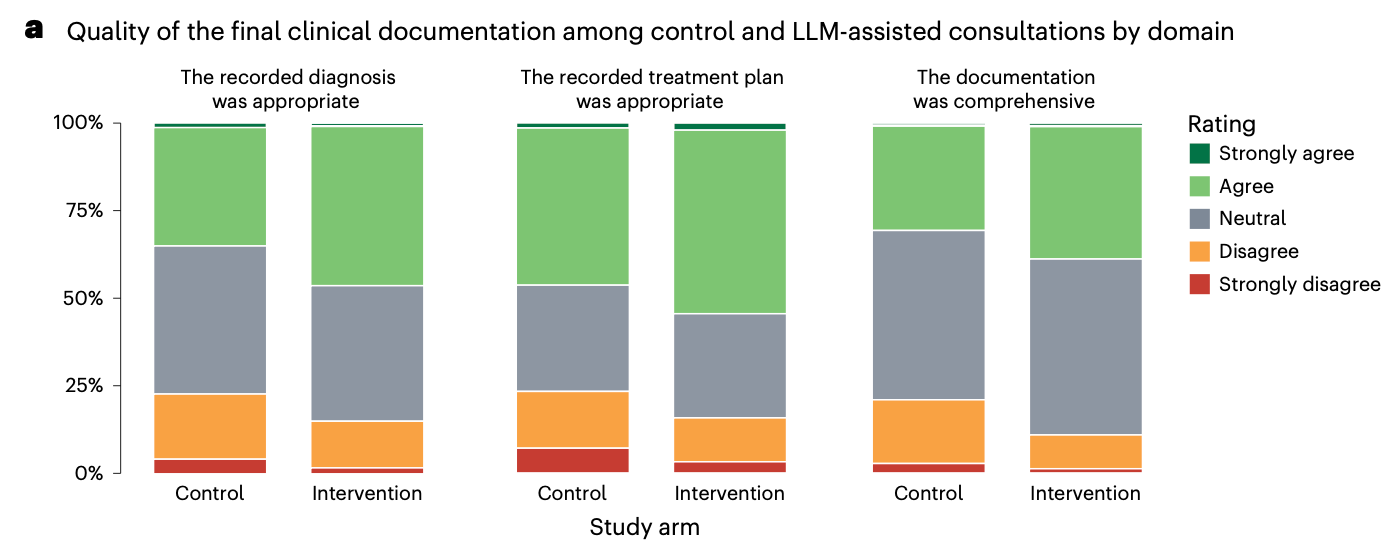
Image Source: nature.com
Key Findings:
No real change in patient outcomes: Treatment failure occurred in 2.2% of AI-assisted patients and 2.0% of the others, a gap small enough to be chance rather than a real effect (adjusted odds ratio 0.77, P=0.13).
Better notes and decisions: Clinicians using the tool were significantly more likely to record the right diagnosis, a thorough note, and a sound treatment plan (odds about 1.7 times higher, all P<0.001).
No sign of harm: An independent review found no serious harm linked to the tool, though the trial was too small to rule out rare problems.
Lower antibiotic costs: Spending on antibiotics was slightly lower when clinicians used the tool, and running the AI cost about US$0.04 per consultation.
Implications for Healthcare Systems:
The AI improved how clinicians documented and reasoned, but did not reduce treatment failures at 14 days. Outcomes also depend on much beyond a single clinic, such as whether patients take their medicine or other social things. For NZ practices weighing generative AI, better notes and decision support do not automatically mean better patient outcomes. Some other limits: one well-run city network, too few treatment failures to detect a small benefit, a short follow-up, and one LLM model that may be surpassed by newer ones. Whether these early gains reach patients is still an open question. The study was independently funded, but two authors also hold stock options in Penda Health, the operator.
Read the full study here.
4. Vitals – Quick Bytes
Collaborative Aotearoa Survey Finds AI Already Embedded in Primary Care, Endorsement and Support Gaps Remain
A survey of health professionals in primary and community care by Collaborative Aotearoa, a national network of PHOs, received 47 responses. Almost half reported using AI daily, and more than two-thirds daily or weekly, with clinical documentation and transcription the most common use, followed by administration and communication support, clinical decision support, and data analysis. Almost all respondents who answered the question supported some form of national endorsement to confirm safety and effectiveness. Awareness of existing pathways, including the National AI and Algorithm Expert Advisory Group (NAIAEAG), remained low, with many unsure whether the tools they use have been assessed. The gap between adoption and endorsement awareness is clear enough to prompt a larger national survey and more active communication of existing AI pathways to health professionals. (HiNZ.org.nz)
Monash University Launches MAVERIC for Secure AI-Enabled Health Research
Monash University has deployed MAVERIC, Australia’s largest university-based AI supercomputer, at CDC Data Centres’ Brooklyn campus in Melbourne, at a cost of AU$60 million. Built primarily with NVIDIA and Dell, the system operates as a Trusted Research Environment, keeping sensitive health datasets under Australian jurisdiction and governance through the Five Safes framework, enabling work at a scale and security level previously unavailable in Australian higher education. Health research projects are already underway, including skin cancer detection, epileptic episode prediction from video-EEG data with MRI, biomarker discovery for multiple sclerosis, and mental health AI model development. All current projects are at an early biomedical research stage, with no patient outcomes data published yet.
We’d love to hear your thoughts, so join the conversation by leaving a comment below:

Stay tuned for more insights in the next edition of The Pulse.
Have a great day & see you in two weeks!
Your Hendrix Health Team