

1. Triage – Your Fortnightly Rundown
Hi Pulse Readers - this week, we’re diving into:
how a Dutch hospital cut radiologist consultations by 70% with AI fracture checks,
what a 153,000-person study shows about spotting osteoporosis on routine chest X-rays,
and how to check an imaging referral against Health NZ’s national criteria with Heidi Evidence.
We’d love your feedback. What would you like to hear more about in The Pulse? Pick one below, and if it’s something else, reply to this email and tell us 🙂
Also, congratulations to our August & September Giveaway Winner 🎉 !
A huge shoutout to Jeremy Dryden, an Emergency Medicine Physician based at Te Whatu Ora - Counties Manukau who has won a Heidi Remote. We wish that he can enhance his emergency consultations with this brand new device!
Now, onto this week’s issue...
2. Case Study – Your Fortnightly Practical
Video Source: Dr Karl Cole (MB ChB, FRNZCGP), Supercharge your GP Practice with Heidi Webinar in collaboration with Health Accelerator and Collaborative Aotearoa
Checking Against A Document with Heidi Evidence
Case Presentation: Previously, Dr Harry used Heidi Evidence to sense-check a complex presentation against trusted sources.
This week, a patient with long-standing osteoarthritis presented with a sore wrist for several days. They take an anticoagulant, so NSAIDs are inappropriate. The patient asks whether a scan would help.
GPs, urgent care doctors and nurse practitioners can now refer patients directly for X-ray, CT and ultrasound, as long as the request meets Health NZ’s national criteria. Dr Harry is unsure whether an X-ray of their wrist qualifies, and a general search could mix in guidance that does not apply in NZ.
He wonders whether Heidi can check the case against the National Community Referral Criteria for Imaging.
Approach: Point Heidi Evidence at one document, then ask questions from inside the consult.
Add the document to your Library
Download the imaging criteria. Open Evidence, then click Library, and upload the criteria under Documents. Select New Collection, name it, for example “National imaging criteria”, and add the criteria to it.
Switch on only that new collection from inside the patient’s session
Use the Evidence bar, which already works from the consult’s context, so you do not retype a patient’s history. Click the sources button next to the brown arrow, switch on only the new collection containing the criteria you uploaded, and turn off every other source, including Clinical web and Literature and guidelines. Every answer is then built from that document alone.
Ask your question
Example prompt: “Can I request an X-ray of this wrist according to national radiology guidelines? Show which criteria are met, unmet or unclear, and cite the relevant sections.”Note: A prompt is the instruction you give an artificial intelligence to tell it what to do. The clearer and more specific the instruction, the better the output.
Save the full check as a snippet and dictate it
In Settings, open Memory, then save the prompt as a New Snippet, such as “radiology criteria check”. Next time, type / and its shorthand, or alternatively you can dictate the Snippet’s verbal trigger, then press Enter.
Example prompt (fuller): “Check this imaging request against the national criteria. Give a red, amber or green result, the reasons, red flags to look for, the priority level, and exact criteria wording to quote in the referral, citing relevant sections of the criteria.”
Check the generated note, then the sources
Heidi Evidence works from the generated note. For example, if the patient reports unexplained night pain that was left out of the note, the check may wrongly say an X-ray does not qualify. This is where a detailed template is useful. It is also good to build a habit of checking the source of where the answer came from, as the clinician remains responsible for the final decision.
Important: The criteria decide public funding. Imaging can still be clinically appropriate and privately funded imaging may be considered.
Outcomes: The check finds that this case does not meet the criteria for publicly funded radiology. It cites the relevant section of the criteria and lists the findings that would make an X-ray eligible, so Dr Harry and the patient can agree on a plan.
Instead of scrolling through a 105-page document, or sending a request that comes back declined, Dr Harry now has an answer within seconds, with the reason and wording to quote. The same method could suit other things like Special Authority for prescribers, ACC contract requirements for allied health, or practice policies for practice managers and governance leads.
Disclaimer: Hendrix Health is the official New Zealand partner for Heidi Health.
3. The Pulse - Your Fortnightly Update
Catharina Hospital in the Netherlands Cuts Radiologist Consultations by 70% with AI Fracture Checks
Catharina Hospital in Eindhoven, the Netherlands, reported on 8 October that AI fracture checks have cut how often its radiographers consult a radiologist by 70%.
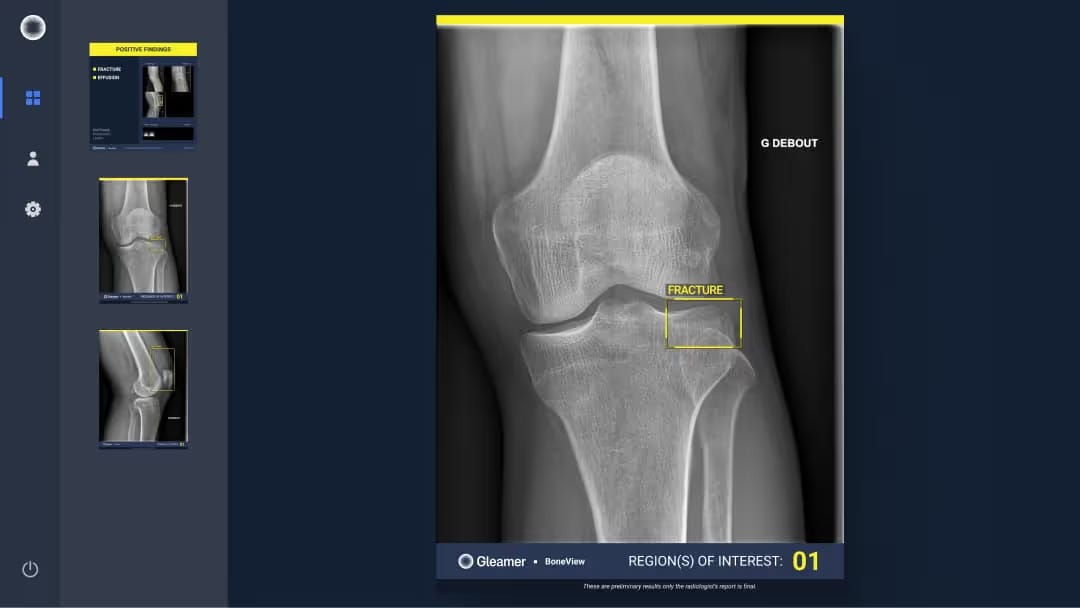
Image Source: Gleamer
When a patient arrives with a suspected fracture, the AI checks the X-ray the moment it is taken, and the radiographer looks at it too. If both see no fracture, or both see a clear one, the radiographer carries on without waiting for a radiologist. Any doubt or disagreement still goes to a radiologist. Patients then reach the plaster room, or go home, sooner.
Previously, radiographers regularly had to interrupt a radiologist’s other work for a quick answer. The hospital says patients benefit most out of hours, when a busy radiologist can take longer to look.
Key Features:
Reported impact: By the hospital’s own account, consultations fell by 70% and time from X-ray to first assessment dropped considerably.
Radiologist still reports every image: A radiologist formally reports every X-ray afterwards, and the hospital stresses that the AI makes no medical decisions on its own.
Already in use elsewhere: Since early 2026, Amphia Hospital in Breda has used BoneView, from French company Gleamer, for patients sent by GPs, after-hours GP services or the ED, with a result within 2 minutes: no fracture, possible fracture, or fracture.
GP after-hours route: Tergooi MC, another Dutch hospital that reported using BoneView in June, lets after-hours GPs send patients with a suspected arm or leg injury straight to radiology, skipping the ED.
Implications for the Health System and Clinicians: Catharina’s radiologist says the biggest gain lies in how the tool fits the workflow, and the hospital is building several new radiology AI projects on that experience. In Aotearoa, radiographers take the X-rays, but the treating clinician in general practice, urgent care or the ED usually reads them first. The radiologist’s report can take a day or two, so the idea worth borrowing is an AI second opinion for that first clinician. The caveat is that the 70% figure is the hospital’s own, with no baseline, time period, product name or accuracy data. Whether acting when the radiographer and the AI agree is as safe as an immediate radiologist read, and how often a later report recalls a patient sent home, still needs independent evaluation.
Spotting Osteoporosis on Routine Chest X-rays: What a 153,000-Person Korean AI Study Shows
A retrospective South Korean study in npj Digital Medicine tested whether AI can spot osteoporosis on routine chest X-rays. Osteoporosis thins the bones so they break more easily, but its standard test, a bone density (DXA) scan, is underused for screening. Chest X-rays, the most common imaging test, could flag who needs one.
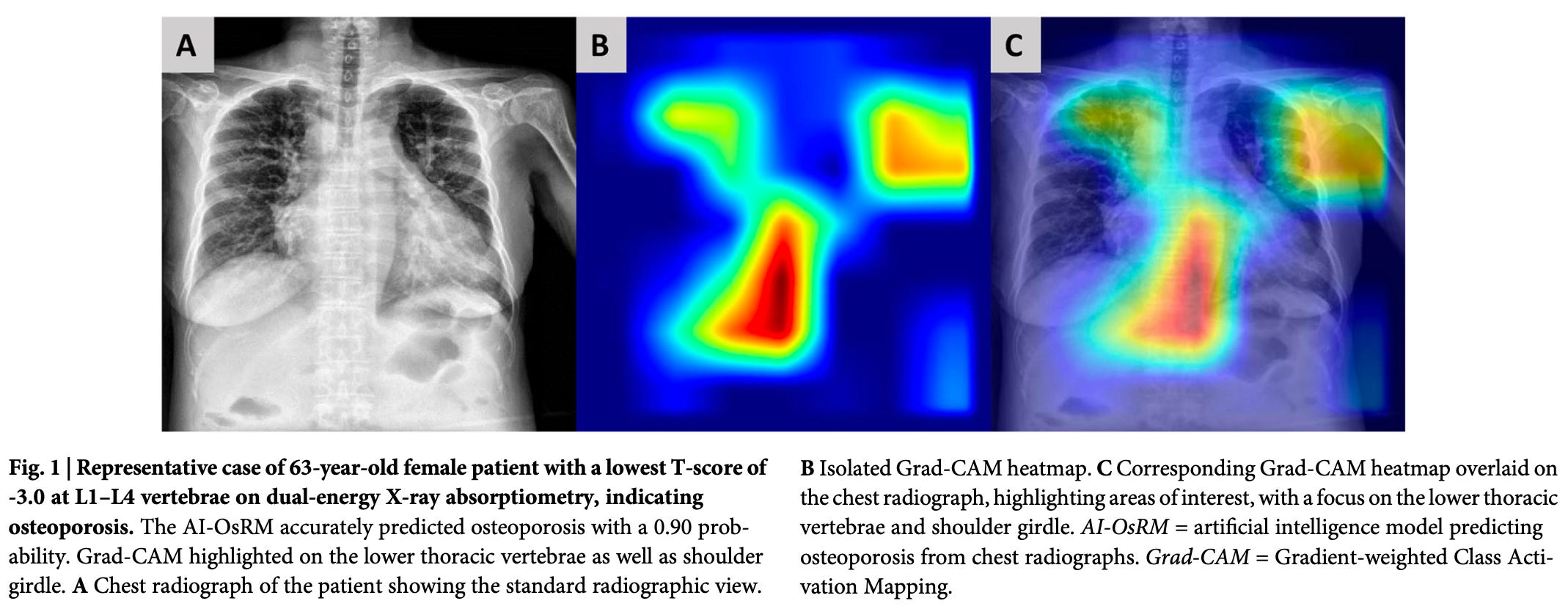
Image Source: npj digital medicine
The AI learned from chest X-rays at one Seoul hospital, each matched to a DXA result, and rates each new X-ray as normal, low bone density (osteopenia), or osteoporosis. Heatmaps of where it looked highlighted the spine and shoulder bones. It was then tested on 153,058 new people, from the same hospital and from routine health check-ups at two centres.
Key Findings:
Accurate in all three groups: At telling apart people with and without osteoporosis, it scored 0.88 in hospital patients, and 0.93 and 0.92 at the check-up centres, where 1.0 is perfect.
Most hospital cases caught: It caught 84% of hospital patients with osteoporosis and correctly ruled out 77% of those without. In those 65 and over, it caught 87% but ruled out only 61%.
About half the scans avoided: In a simulation at the check-up centres, sending only those the AI rated higher risk for DXA would have cut scans by 46% and 58%, still catching 99% and 98% of osteoporosis cases.
Cut-off needs local tuning: At the larger centre, where most were under 50, the AI’s original cut-off flagged fewer than 1 in 10 people and caught only 53% of osteoporosis cases. The simulation’s looser cut-off flagged about 4 in 10 and caught 98%.
Implications for Healthcare Systems:
For New Zealand, this is AI getting more from a test already done - a chest X-ray taken for a chest infection could also flag thinning bones and prompt a DXA referral. However, the study looked back at past records where everyone had already had DXA, so it could not show the AI finding people who would otherwise go untested. Built and tested only in Korea, against Asian bone density norms, it still needs checking in New Zealand patients, including Māori and Pacific peoples.
Read the full study here.
4. Vitals – Quick Bytes
Healthpoint Launches a Free AI Navigator for 12,000 New Zealand Health Services
Healthpoint, New Zealand’s national directory of health services, has launched Ask Healthpoint, a free AI tool for finding the right local service. People describe their need in their own words, such as “I have a sore ear”, in many languages including te reo Māori and Samoan, and get nearby options with opening hours, contact details and whether an appointment is needed. It does not diagnose, triage or assess anyone, but shows “get help now” prompts when support is urgent. Testing covered more than 600 real-world scenarios, including mental health and emergency care. Healthpoint says complete listings appear more prominently, and practices can embed the tool on their own websites. However, no usage or outcome data has been published since its 29 June launch.
AI Biopsy Test Changes 27.5% of Hormone Therapy Decisions in Australian Prostate Cancer Trial
An interim analysis of a 28-centre Australian implementation trial studied an AI biopsy test in 200 men having radiotherapy for intermediate-risk prostate cancer. Adding short-term hormone therapy can make radiotherapy more effective, but it carries side effects. The test reads digitised biopsy slides with routine clinical data to predict who is likely to benefit. Each man and his clinician made a shared decision before and after seeing the result. The test predicted a benefit for only 15% of men, and testing changed 27.5% of decisions. Of 74 men who first opted for hormone therapy, 52 (70.3%) switched to no; only 3 of the other 126 (2.4%) switched to yes. The caveats being that no cancer outcomes are reported yet, and there was no comparison group.
We’d love to hear your thoughts, so join the conversation by leaving a comment below:

Stay tuned for more insights in the next edition of The Pulse.
Have a great day & see you in two weeks!
Your Hendrix Health Team