

1. Triage – Your Fortnightly Rundown
Hi Pulse Readers - this week, we’re diving into:
the NHS’s largest surgical AI evaluation to treat more patients in existing theatres,
what a study reveals about moving a self-harm AI surveillance tool between hospitals,
and how to use Heidi’s template syntax to generate notes in your own style.
Also, congratulations to our GPCME South Conference Giveaway Winner 🎉 !
A big shoutout to Theresa Koen from Turuki Health Care who has won a Heidi Remote by subscribing to The Pulse. Enjoy staying hands-free and focused on your patients!!
There is still one more Heidi Remote to be won by one lucky subscriber. Our September giveaway closes in two weeks, and every new subscriber since August is in the draw.
Now, on to this week’s issue...
2. Case Study – Your Fortnightly Practical
Video Source: Dr Karl Cole (MB ChB, FRNZCGP), Supercharge your GP Practice with Heidi Webinar in collaboration with Health Accelerator and Collaborative Aotearoa
Editing Template Structure with Syntax
Case Presentation: When Dr Harry first started with Heidi, he built a template by uploading a de-identified example note to Heidi.
One of those templates has been producing outputs that are not quite his style. A section he wants as a short list comes back as full paragraphs. Notes sometimes appear under another section when nothing relevant was discussed. He would also like a standard sign-off on every note. He opens the template editor, switches to the Structure tab, and finds brackets and quotation marks he does not fully understand.
He wonders what each part means, and how to customise the template so Heidi writes like him.
Approach: Understand what each part of the template syntax controls, so you can shape the output to match your style of documentation.
Open the Structure tab of a template editor
From a note, select the three dots beside the scribe style, choose View / edit template, then click on the Structure tab.
Note: You can also change a template by editing the example note or by asking Heidi in plain language, and Heidi updates the structure for you automatically.
Write section headings in plain text
Type each heading as ordinary text, for example HxPc, OE, imp, plan. Text without brackets appears in the note as written, so your headings stay in place every time.
Use square brackets to signal what information to include
A placeholder in square brackets tells Heidi what information to insert, for example [Describe patient's presenting complaint]. Describe the type of content you want rather than a specific example, and Heidi fills it from the consult.
Use round brackets for how to handle it
An instruction in round brackets tells Heidi how to write a section, for example (Write in narrative paragraphs with full sentences) or (List as bullet points using dashes). Place it beside a placeholder to apply it there.
Important: To stop Heidi filling gaps with assumptions, add a safety instruction such as (Only include if explicitly mentioned in transcript, contextual notes or clinical note, else omit section entirely). Always remember to review the generated note for accuracy before copying it into your PMS or EHR.
Use quotation marks for exact wording
Text in quotation marks appears word for word, every time. Use it for fixed lines such as "Signed Dr John Smith, Cardiologist".
Add conditional logic for rules that change
For content that depends on the situation, write an if / then instruction in round brackets, for example (If no allergies are mentioned, write NKDA), or (If no examination findings are mentioned, write "Examination not formally done"). This keeps routine entries like allergies and examination findings consistent without editing each note by hand.
Outcomes: Now the template has been edited for Heidi to write in Dr Harry’s style. The list stays a list, the unwanted section stays out unless it comes up, and his sign-off appears each time.
Understanding the syntax means he can customise a template for any recurring task - an ADHD review, a rest home progress note, or an ACC report. Heidi is writing notes just like him, and Dr Harry makes fewer edits to them.
Disclaimer: Hendrix Health is the official New Zealand partner for Heidi Health.
3. The Pulse - Your Fortnightly Update
NHS Launches Its Largest Surgical AI Evaluation to Treat More Patients in Existing Theatres
Eight NHS hospitals have begun the largest surgical AI evaluation yet run in the health service, a year-long programme announced just last week. Led by UK health technology company Proximie, with Amazon Web Services (AWS) and Deloitte, it deploys Proximie's Intelligence Suite across 104 operating theatres, endoscopy suites, and catheterisation laboratories at the eight sites, six in London and two elsewhere in England.
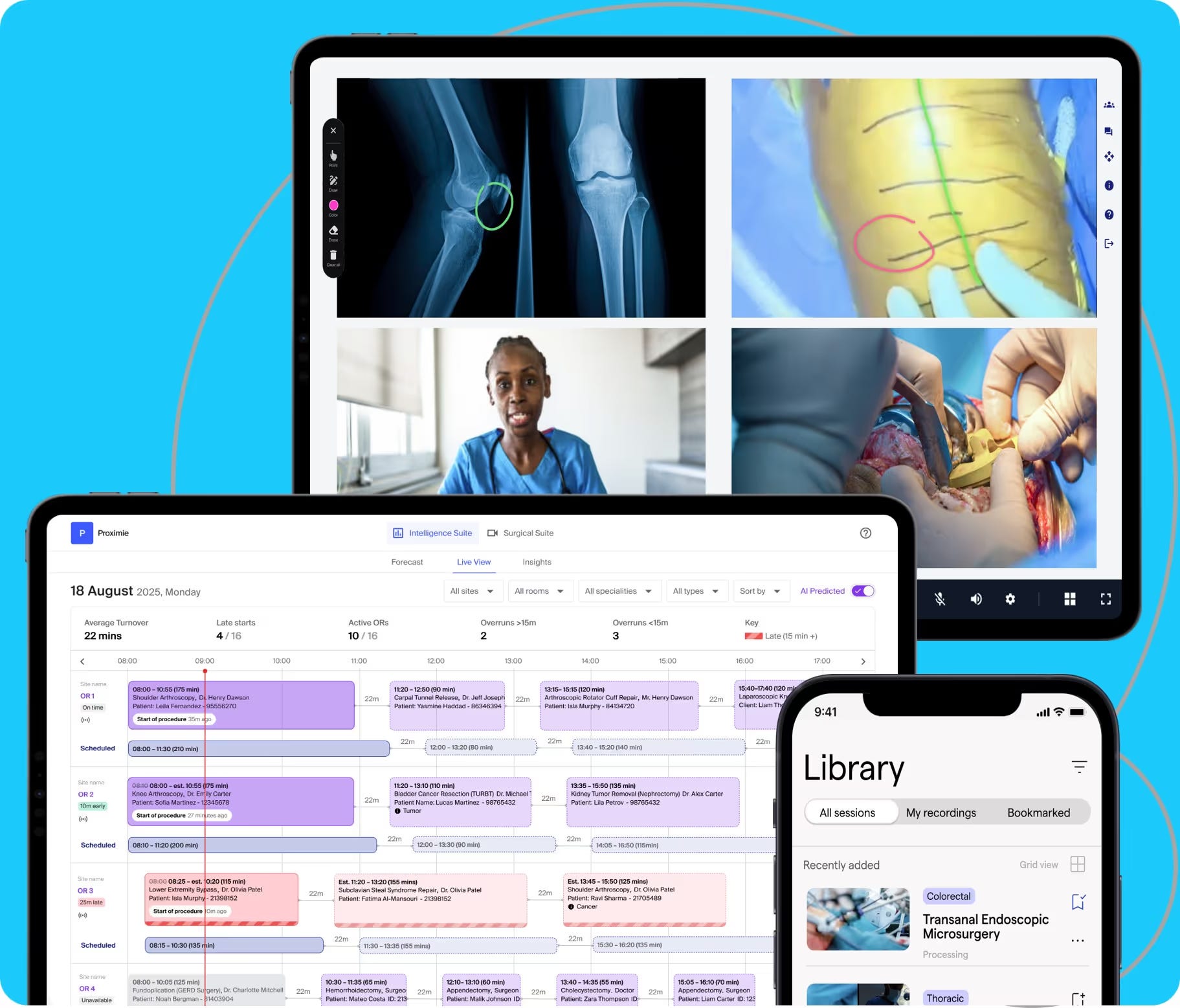
Image Source: Proximie
Operating theatres are among a hospital’s most expensive rooms, and a share of their time is lost in the gaps between one operation and the next.
The aim is to treat more patients across more than 20,000 procedures a year using existing theatres and staff, without longer working hours.
Key Features:
Runs in the background: the tool captures surgical video and procedural data from every room as the list proceeds, without disrupting the surgical team
Anonymised at source: identifying details are removed at the point of capture, so the system works only from the timing and flow of the list
Live visibility for the whole team: it turns that data into real-time predictions and alerts, giving nurses, surgeons, anaesthetists, and operational leaders a live view of theatre turnover, utilisation, on-time starts, and variability to act on
Early results at live sites: where it already runs, at University Hospitals Coventry and Warwickshire and at Barking, Havering and Redbridge, Proximie reports an 8.2% increase in cases, a 30% reduction in turnover time, and the potential for one extra case a day
Implications for the Health System and Clinicians: This is AI aimed at the operational side of care, patient flow through costly, resource-heavy theatres, and it leaves clinical decisions to the team. For Aotearoa, where elective waiting lists and workforce shortages are constant pressures with little room to add theatres or staff, getting more from the theatres already running is worth watching. The caveat is that the headline figures are early and company-reported from a handful of sites. It would be interesting to see whether they hold across eight hospitals over a full year, and translate into shorter waits rather than simply busier theatres.
AI for Public Health Surveillance: What a Study Reveals About Moving It Between Hospitals
Most healthcare AI aims to help treat an individual patient. This tool has a different job: public health surveillance. In a study in PLOS Digital Health, an Australian team tested an AI that reads emergency department triage notes to track self-harm across a population, the strongest risk factor for later suicide.
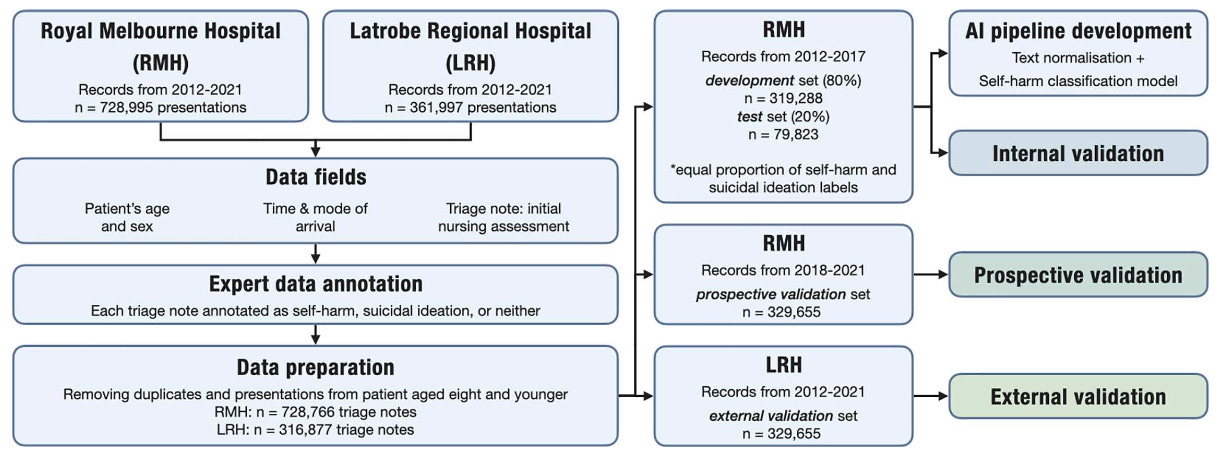
Image Source: PLOS Digital Health
The team asked whether a tool built at one hospital still works when it moves to another. Developed at the University of Melbourne on notes from the metropolitan Royal Melbourne Hospital, it was tested there over four years and at Latrobe Regional Hospital, 150 km away. The system cleans up the brief, error-filled triage text, then a machine-learning model flags the notes whose wording signals current self-harm. It was validated on 329,655 metropolitan and 316,877 regional notes.
Key Findings:
Stable at the city hospital: At Royal Melbourne, the tool held its performance, scoring 0.84 where 1.0 is perfect.
Weaker at the regional hospital: At Latrobe Regional, its ability to pick out self-harm fell to 0.78, with precision of 71% and sensitivity of 73%.
Local wording and methods drove the gap: The regional notes were written differently, and self-harm there more often involved medication overdose than self-injury.
Better than codes, not yet for individual care: It catches far more self-harm than diagnostic coding, which misses over 60%, though about 23% of what it flags may be suicidal ideation.
Implications for Healthcare Systems:
For New Zealand, the wider lesson is about AI itself. As health services push AI out from big city hospitals to smaller rural ones, a tool proven in one setting cannot be assumed to work in another, since local wording and patient populations can quietly erode it, a risk for rural and underserved communities. As a validation study rather than a trial, and one that still confuses some self-harm with suicidal ideation, it points to local tuning and prospective testing before clinical use.
Read the full study here.
4. Vitals – Quick Bytes
AI Early-Warning Tool Linked to Fewer Ward Cardiac Arrests in Resource-Limited Korean Hospitals
A retrospective study tested DeepCARS, an AI-SaMD that predicts which ward patients are likely to have a cardiac arrest within 24 hours. It uses just four routine vital signs, and flags a risk score inside the usual electronic record alongside existing EWS. Three secondary hospitals in South Korea have adopted it because they cannot afford a rapid-response team. It alerts the bedside team when a patient's score climbs. No extra staff are needed. Across 164,761 ward admissions, DeepCARS’s use was linked to 21% fewer cardiac arrests and 15% fewer in-hospital deaths. The gains were larger in patients with sepsis. However, the study was retrospective, so it shows association rather than cause, and the authors also say that RCTs are needed to confirm it.
Health New Zealand Introduces a National Framework to Assess AI Tools Before Use
6 weeks ago, Health NZ introduced a national framework for checking AI tools before they enter the health system. The New Zealand AI Pre-Implementation Evaluation Framework sets one consistent way to judge whether a tool is safe, secure, ethical and equitable. It was built over 18 months as a Health Research Council project, led by Associate Professor Rosie Dobson. It is tailored to a country like NZ, with no specific AI law. The Health NZ Board has endorsed it as the method its National AI and Algorithm Expert Advisory Group will use to assess new tools in the public health sector.
We’d love to hear your thoughts, so join the conversation by leaving a comment below:

Stay tuned for more insights in the next edition of The Pulse.
Have a great day & see you in two weeks!
Your Hendrix Health Team