

1. Triage – Your Fortnightly Rundown
Hi Pulse Readers - this week, we’re diving into:
Tāmaki Health's rollout of NZ's first primary care AI health coach,
how an AI tool reads a standard pathology slide to flag bowel cancer relapse risk,
and how to explain Heidi's data journey in plain language.
Also, congratulations to our July Giveaway Winner 🎉 !
A big shoutout to Victoria Purdy from Workfit Auckland and O Hands Hand Therapy Clinic who has won a Heidi Remote. Use it well across both of your practices!!
Now, on to this week’s issue...
2. Case Study – Your Fortnightly Practical
Video Source: Hendrix Health
Following Your Patient's Information Through Heidi
Case Presentation: Last time, Dr Harry found his everyday note controls in one menu on the note screen.
This fortnight, a patient asks him a question after providing her consent for Heidi to transcribe the consultation. She wants to know where the recording goes, who can listen to it, and whether their conversation will be used to train any AI. Dr Harry answers honestly but thinly: the tool is secure, and he reviews every output himself.
Dr Harry realises he could not explain exactly what he was asking his patients to agree to. He wonders whether he can learn the path a patient's information takes, well enough to explain it simply.
Approach: Understand how information is passed through Heidi, so you can describe it to a patient in plain language.
No audio recording is stored
Heidi transcribes as you speak and as soon as the speech is transcribed into text, the underlying audio disappears. The transcription occurs in real-time - think of it like the microphone button on your phone's keyboard, where your speech becomes text as you go.
Files you place in the context window, a referral, a specialist letter, or photographed ambulance notes, are also converted to text and treated as part of that session, so add only what the note needs.
How identifying information is protected
Identifying details are automatically removed from the transcript and replaced with placeholders, so a patient's name becomes something like Jane Doe or John Smith. Those identifiers sit in a separate secure vault, protected by their own layer of digital lock and key. The de-identified clinical text is then processed by large language models into a polished output, following the instructions in your template.
Note: At this stage the identifiers are released from the vault, and swapped back into the output. Please review any regenerated or edited note for accuracy before it goes out.
Data is not used to train AI
Consultation data, session transcripts, and generated notes are not used to train AI models. This is often the question patients care most about, and it can be answered directly.
Decide how long sessions are kept, and know that deletion is final
You choose how long Heidi keeps a session, from one day through to indefinitely. The default is to keep it, so set a period that matches your practice’s records policy. Once a session is deleted, it cannot be recovered.
Outcomes: Instead of a general reassurance and a hope that the patient does not press further, Dr Harry can now describe what happens to information from a Heidi transcript in a few sentences. Explaining it plainly upholds the patient’s mana over their own health information.
The same knowledge sits behind every consent conversation his team has. Patients and their whānau who understand where their information goes are better placed to make their own decisions.
Disclaimer: Hendrix Health is the official New Zealand partner for Heidi Health.
3. The Pulse - Your Fortnightly Update
Tāmaki Health Launches New Zealand's First Primary Care AI Health Coach
Tāmaki Health, one of New Zealand's largest privately owned healthcare providers, has become the country's first primary care organisation to bring an AI health coach into routine care, partnering with digital health company Groov. The tool launched on 27 July 2026 and is now piloting across selected clinics.
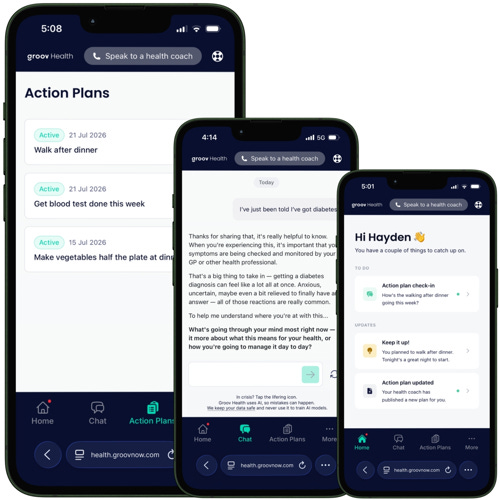
Image Source: Tāmaki Health
The coach acts as a 24/7 digital front door. Patients can start a coaching conversation even before they book an appointment. It then helps them build personalised action plans for lifestyle and behaviour change, covering conditions such as diabetes, gout, weight, and anxiety.
The AI coach extends Tāmaki Health’s established health coach service. The provider says that service has improved management of chronic conditions and cut unnecessary clinic visits. Tāmaki Health says primary care cannot meet rising demand by adding appointments alone.
Key Features:
Human in the loop: The coach handles early, lower-intensity support and hands patients to Tāmaki Health’s coaches and clinical teams when symptoms, distress, or requests for more help appear.
Purpose-built platform: Powered by Groov, maker of Ask Groov (Health New Zealand’s first endorsed AI wellbeing guide), it uses clinically reviewed content and defined escalation pathways, and is security-tested and ISO 27001 certified.
Built on a proven model: It is modelled on NZ’s Integrated Primary Mental Health and Addiction (IPMHA) programme and co-designed with patients and Tāmaki Health’s clinicians and coaches.
Early results: Across more than 4,500 coaching conversations, users' self-rated confidence to manage their health rose an average of 32% after one session and 75% by month two. They rated the coach 8.5 out of 10 for helpfulness.
Equity focus: The providers see earlier, more accessible preventative support as especially relevant for Māori and Pasifika communities, who carry a disproportionate burden of chronic disease.
Implications for the Health System and Clinicians: This is a local example of AI extending a proven human service rather than automating a clinical decision. Support that reaches patients between visits speaks directly to access and equity in Aotearoa. The partners will evaluate engagement, access, and outcomes as the pilot expands. However, these figures are early, self-reported, and come from a company-run pilot. Whether short-term gains in confidence become lasting behaviour change and measurable clinical improvement, across diverse populations, is the real test.
Refining Risk in Stage II Colorectal Cancer: What a 1,220-Patient Australian AI Study Tells Us
An Australian study in Gastroenterology tested an AI tool that reads a standard pathology slide to predict which stage II bowel cancer patients are most likely to relapse. This is the hardest time to make decisions about chemotherapy. Led from La Trobe and Melbourne universities, the AI was trained on a separate patient group with more advanced cancer, then tested on three patient groups, two external.
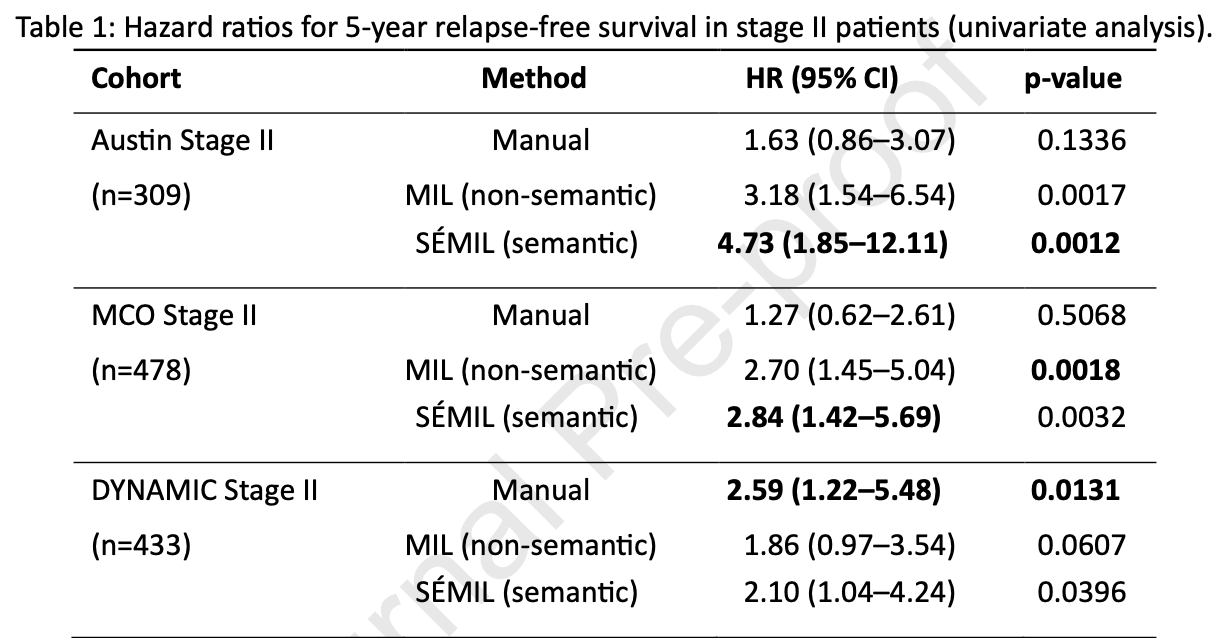
Image Source: Gastroenterology (AGA Journal)
The tool, called SÉMIL, looks at the edge of the tumour, where it meets healthy tissue, and judges whether that border is jagged (higher-risk) or smooth (lower-risk). Pathologists know this border matters, but it is too subjective to judge it by eye. SÉMIL scores an ordinary slide with no extra lab tests, with scores checked against whether patients stayed cancer-free over five years.
Key Findings:
Spotted higher-risk patients: In all three groups, patients it flagged higher-risk relapsed about 2-5 times as often as lower-risk patients (hazard ratios 4.73, 2.84, 2.10; all statistically significant).
Helped with the hardest cases: Even among patients already rated high-risk by current guidelines, where the call is toughest, it still picked out those at greatest risk in every group (hazard ratios 2.96 to 3.50).
Added something new: After accounting for the risk factors pathologists already check, such as tumour depth and lymph node sampling, the AI tool still predicted relapse on its own, roughly doubling the risk (hazard ratio 1.98).
Best paired with a pathologist: When tool and pathologist agreed a border was high-risk, those patients did worst of all (hazard ratio 3.96).
Implications for Healthcare Systems:
New Zealand has one of the world's highest bowel cancer rates, so a tool that reads risk from an existing slide, with no extra test, could help decide which stage II patients need chemotherapy after surgery and which can be safely spared. It can also act as support for pathologists. However, this was a retrospective study on stored slides, all from Australia, and the researchers say it must be tested in real time, guiding treatment, before it changes care.
Read the full study here.
4. Vitals – Quick Bytes
RCT Shows That AI-Trained Physicians Diagnose Better in a LMIC
A single-blind RCT in Pakistan tested whether large language models improve clinical reasoning in a lower-middle-income setting. After all 58 participating physicians completed a 20-hour AI-literacy programme, they were randomised to review up to six clinical vignettes with either GPT-4o + conventional resources or conventional resources alone. Those with LLM access scored a mean 71.4% on an expert-validated diagnostic reasoning rubric, against 42.6% for the control group, with no meaningful change in time per case. Some caveats: the study used vignettes rather than real patients, tested only GPT-4o across six cases, and did not include an untrained physician group with LLM access, to separate the AI training effect from the effect of merely having access to AI.
HealthX and RosterLab Pilot AI-Powered Rostering Across Four New Zealand Sites
Health New Zealand's digital innovation programme, HealthX, has confirmed a contract with RosterLab, which provides AI-powered healthcare rostering software, for an initial pilot across four sites: Counties Manukau, Waikato, Starship, and Waitematā. From July 2026 the pilot covers medical radiation technologist (MRT) services and other clinical staff. The platform uses optimisation and AI-assisted workforce management to build rosters that balance operational requirements, staff preferences, fatigue, skill mix, and compliance. It is a very tightly controlled expansion from around 500 clinicians rostered to about 900. RosterLab reports that an earlier project with Middlemore MRTs cut a 120-hour monthly rostering task to under 20 hours a month. This pilot is early, and no independent outcomes have been reported yet.
We’d love to hear your thoughts, so join the conversation by leaving a comment below:

Stay tuned for more insights in the next edition of The Pulse.
Have a great day & see you in two weeks!
Your Hendrix Health Team