

1. Triage – Your Fortnightly Rundown
Hi Pulse Readers - this week, we’re diving into:
how a Pacific-led provider halved nurse travel time with AI remote monitoring,
what an 11,000-patient ANZ registry study shows about mortality risk after hip fracture surgery,
and how to reach your everyday note controls from one menu in Heidi.
2. Case Study – Your Fortnightly Practical
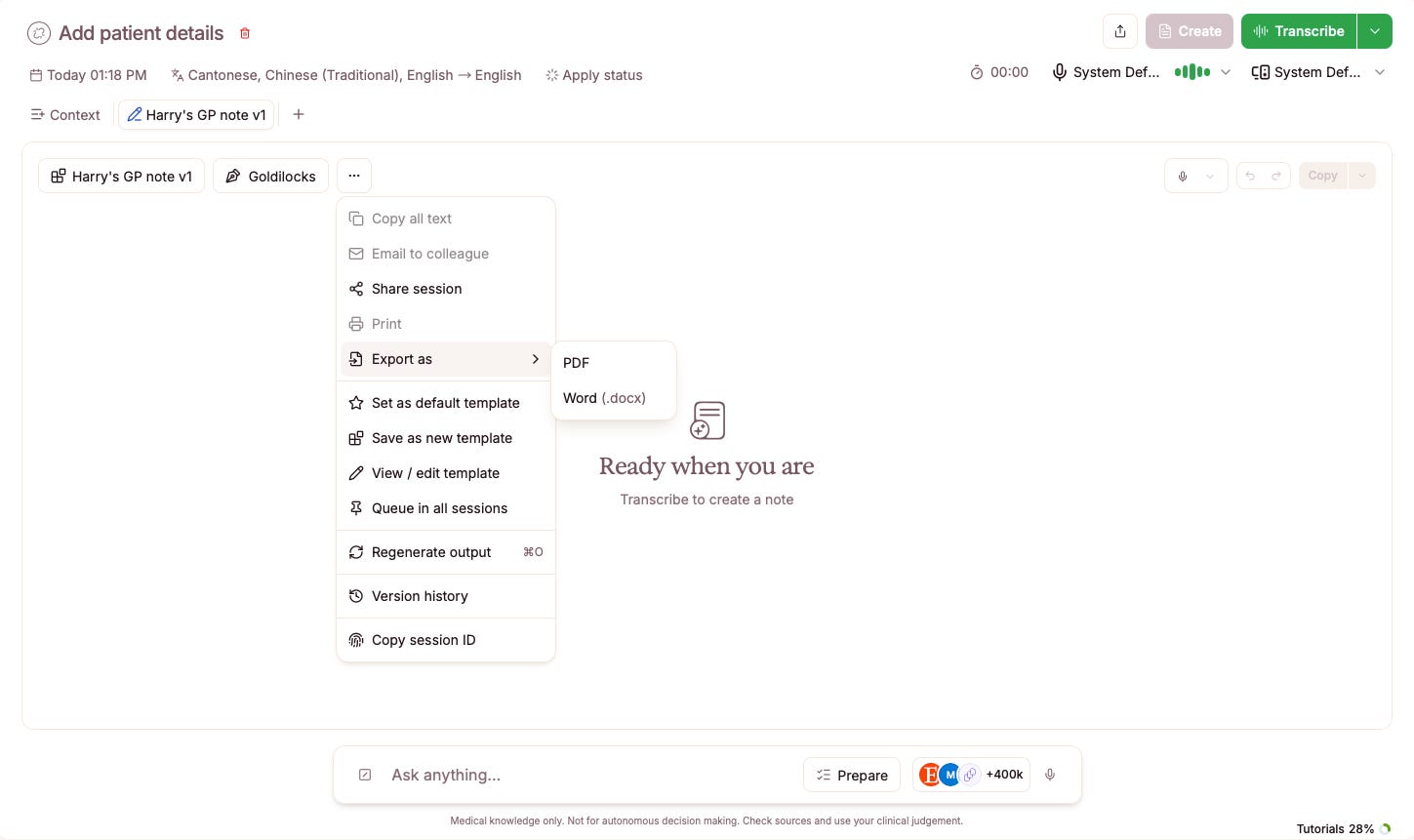
Image Source: Heidi Health
Finding Your Everyday Controls On the Spot
Case Presentation: Since last time, Dr Harry has been using Heidi Dictate to speak text into any application on his computer.
Lately he is thinking about the small changes he makes over and over. He switches his default template, adjusts a template that is not quite right, and checks an earlier version of a note when he has second thoughts about an edit. Each change sends him somewhere different: into Settings, across to the Templates tab, or back through several clicks to where he started.
Each step is simple on its own, though the back-and-forth breaks his flow between patients. Dr Harry wonders whether these everyday controls could sit closer to the note he is working on.
Approach: Open the more options menu on the session interface (the three dots at the top of a note) and access multiple controls all in one place.
See what the menu offers from where you already are
On any note, select the three dots beside the template name and scribe style. The template settings, export controls, and version history all sit here, so you can make routine changes without leaving the note screen and taking multiple steps.
Make your everyday setup automatic
Choose Set as default template so your current template becomes pre-selected for every new session. If you regularly need more than one document from a consult, for example a note and a patient letter, choose Queue in all sessions so each is generated as soon as you stop transcribing.Keep or adjust a template on the spot
When you have edited a note into the way you like, choose Save as new template to reuse it. Choose View / edit template to open the editor and change the headings, wording, or instructions without hunting for the template elsewhere.
Regenerate and roll back with confidence
After editing or changing a template, choose Regenerate output to rewrite the current note using the latest version. Choose Version history to see what changed, who changed it, and roll back to an earlier version in one click.Send or export a finished note
The menu also includes Copy all text, Email to colleague, Share session, Export as PDF or .docx, and Print, which stay greyed out until a note is generated. Use them to pass a note to a covering colleague or file a copy directly.
Important: Review any regenerated or edited note for accuracy before it goes out. You remain responsible for the final note.
Outcomes: Rather than moving between Settings, the Templates tab, and the note screen for routine changes, Dr Harry now reaches these controls from one menu on the same screen. His default template is set, his common documents are queued, and an edit he is unsure about can be checked or undone in seconds.
For a busy clinician, having these controls in one place removes small interruptions that used to sit between him and the next patient. His attention stays on the note in front of him.
Disclaimer: Hendrix Health is the official New Zealand partner for Heidi Health.
3. The Pulse - Your Fortnightly Update
Pacific Health Services Hutt Valley Halves Nurse Travel Time with AI Remote Monitoring
Pacific Health Services Hutt Valley, a Wellington-based Pacific-led provider serving more than 17,000 Pacific people, has cut nurse travel time in half after deploying an AI-enabled remote monitoring platform. The provider began piloting the tool, Speedback, in December 2024, and presented its results at the Te Tītoki Mataora Forum on 2 July 2026.

Image Source: sisgain.ae
Built by Singapore-based Equitech, the platform uses WhatsApp and SMS rather than a dedicated app. Patients submit blood pressure, blood sugar, wound images, and meal photos for nutritional feedback, which AI interprets to help monitor diabetes and other long-term conditions between 3-month checks. Clinicians review the trends and send personalised nudges.
Before Speedback, a single clinician could actively monitor around 8 clients through in-person visits, sometimes travelling to a home just to take a blood pressure for a family without transport.
Key Features:
Workforce reach: Within 3 months, the provider reported nurse travel time and administrative workload each fell by 50%, letting monitoring scale from about 8 clients per clinician to 321 without adding staff.
Runs on WhatsApp: Using a channel Pacific communities already rely on to stay in touch with family in the islands means there is nothing new to download or learn.
Multilingual by design: Messages are available in Samoan, other Pacific languages, and Te Reo Māori, lowering the language barrier for the Pacific families the service reaches.
Clinician in the loop: Clinicians monitor the trends and decide when to reach out, keeping clinical judgement with a person rather than the tool.
Implications for the Health System and Clinicians: This shows AI extending the reach of a small workforce rather than making clinical decisions, shifting care from episodic visits towards continuous community monitoring. For Aotearoa, where workforce shortages, transport barriers, and Pasifika health inequities are persistent pressures, a tool that lets one clinician follow more patients speaks directly to access and equity. The provider frames it as a return on investment for reaching more of its community. However, these figures are provider-reported from an early pilot. Whether the gains hold across a full year and other settings, and whether remote monitoring actually improves patient outcomes rather than workforce efficiency alone, remains to be shown.
Ranking Mortality Risk After Hip Fracture Surgery: What an 11,000-Patient ANZ Registry Study Shows
A retrospective study in Anesthesia & Analgesia used machine learning to rank the factors that best predict death after hip fracture surgery. The Australian-led team drew on the Australian and New Zealand Hip Fracture Registry, analysing 11,318 patients treated across 107 hospitals between 2016 and 2019.
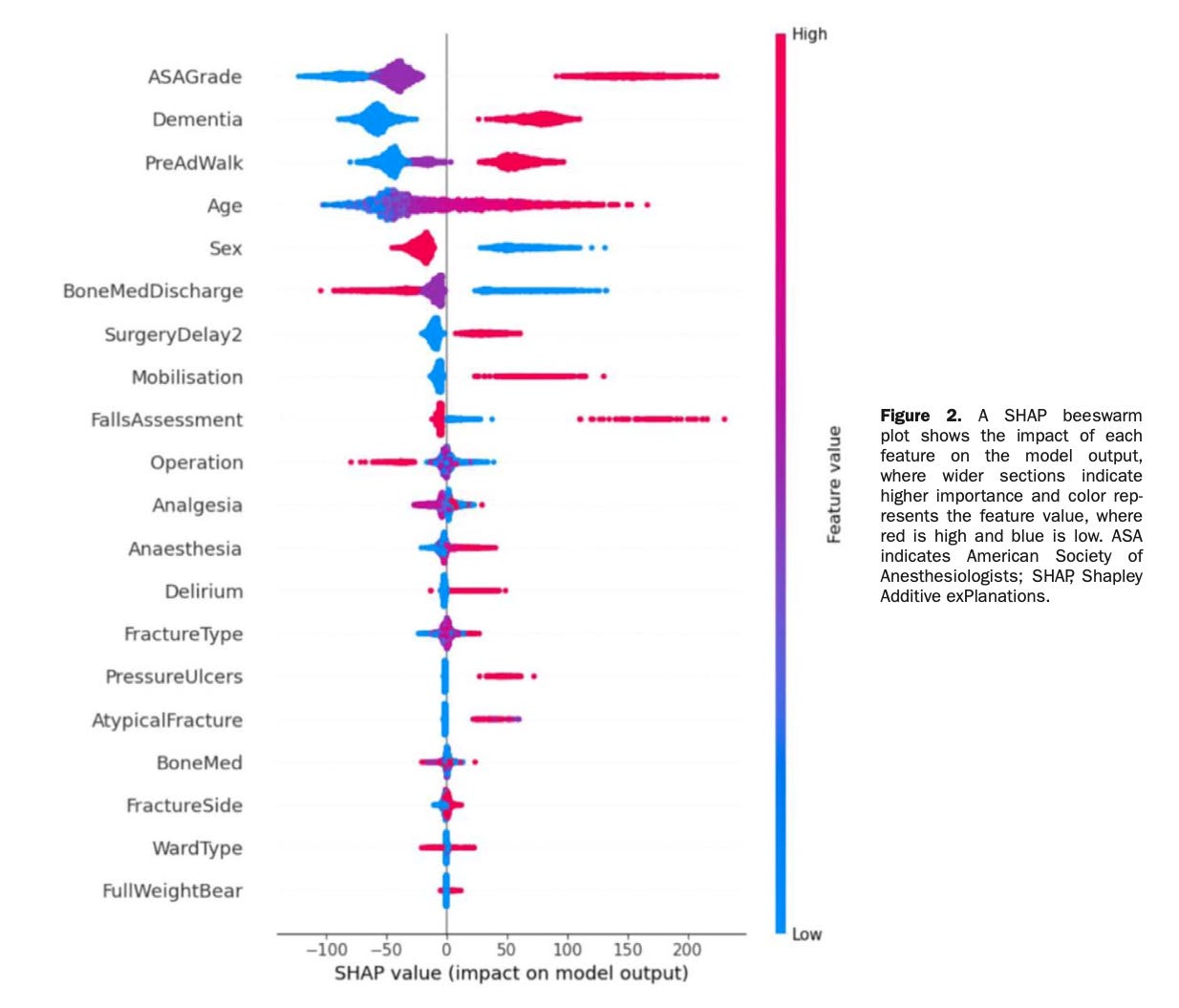
Image Source: anesthesia-analgesia.org
Instead of a traditional statistical method, the team used a Random Survival Forest, a machine-learning approach suited to the many interacting factors and changing risks in these patients. It weighed 20 routine demographic, clinical, and perioperative variables and ranked each by how much it helped predict when a patient would die. The cohort had a mean age above 80, with dementia in 38% and an ASA grade of III or higher in 80%. Over a median follow-up of 630 days, 31% died.
Key Findings:
Model performance: On patients it had not seen, the model correctly ranked who was at higher risk of dying about 73% of the time.
ASA grade ranked first: Physical status, measured by ASA grade, was the strongest predictor of mortality (importance score 0.051).
Dementia, age, and mobility followed: Pre-existing dementia (0.036), age (0.019), and pre-admission walking ability (0.016) ranked next, and 40% of those who died had dementia.
Weaker contributors: Male sex, length of hospital stay, and bone medication at discharge added comparatively little.
Implications for Healthcare Systems:
For an ageing population where hip fracture is common and often fatal, a model built from information hospitals already hold offers a practical way to flag who is most at risk and support goals-of-care discussions. Because the registry includes New Zealand patients, the findings reflect local practice. The caveat is that the model identifies higher-risk patients; it does not explain what causes the risk or how to change it. The predictors (ASA grade, dementia, age, and mobility) are already familiar, so its value lies in ranking and clarity, and the authors say the findings need confirming in other patient groups.
Read the full study here.
4. Vitals – Quick Bytes
RNZCGP Study Finds Patients and Clinicians Accept Health Data Use for AI, if It Serves the Greater Good
A New Zealand interview study asked 51 patients and health professionals about using personal health information to build AI tools and use them in care. Divided into three groups, all accepted secondary use of their data only if it serves the greater good (vs commercial gain), and felt the NZ health system should benefit when a company profits from a resulting tool. All valued AI's potential to reduce administrative burden, and tied patient trust to transparency, consent, and strong governance, with Māori representation and data sovereignty raised as important to that trust. Every group agreed AI should support clinicians, not replace them. The authors caution this was a small qualitative study with few Pacific participants, and conclude no single approach to social licence is likely.
Viz.ai Expands Its Stroke Coordination Model Into Pulmonary Care
Back in Issue 5, we covered Viz.ai, the US platform across 2,000 hospitals that flags a suspected stroke on a CT scan and cut specialist notification from 45 minutes to 7. On 14 May 2026 the company launched the Viz Pulmonary Suite, applying the same detect-and-coordinate approach to three lung conditions: COPD, lung nodules, and pulmonary embolism (PE). For PE, the tool flags the clot on imaging and mobilises the treating team: in a single-centre study it reduced time to treatment from 1.75 days to 0.56 days and lowered in-hospital mortality among high-risk patients. Viz.ai has since signalled a move into multiple sclerosis. The caution is that these new-area results come from a single site and a company launch rather than independent evaluation. (Viz.ai)
We’d love to hear your thoughts, so join the conversation by leaving a comment below:

Stay tuned for more insights in the next edition of The Pulse.
Have a great day & see you in two weeks!
Your Hendrix Health Team