

1. Triage – Your Fortnightly Rundown
Hi Pulse Readers - this week, we’re diving into:
how an NHS trust used agentic AI to reduce routine IT help desk demand,
research showing UK patients turning to AI chatbots before contacting their GP or NHS services,
and how practices can set clear rules for controlled AI use that staff can actually follow.
2. Case Study – Your Fortnightly Practical

Image Source: essert.io
Creating a One-Page AI Policy For Your Practice
Case Presentation: Dr Harry has been using Heidi for his consult notes for a few months. Other clinicians in the practice have started using it too.
The practice manager has noticed something else. One clinician is using ChatGPT to tidy up patient instructions. A nurse has asked another AI tool to rewrite an educational handout. Reception has used Google AI to draft a patient message about a missed appointment.
The issue is that everyone is making their own judgement call and it is unclear which tools are approved, what patient information can be entered, what patients need to be told, or who is responsible for checking the final output.
The practice needs a simple, shared rulebook that staff can actually follow.
Approach: Create a one-page AI governance policy that covers the basics: approved tools, patient information, consent, review, and ownership.
List the approved tools
Start with a short table. Name the AI tools the practice allows, what each one can be used for, and who is allowed to use it. For example, a tool like Heidi may be approved for clinical documentation, while general AI tools may only be approved for non-identifiable admin writing.
Set the patient-information rule
Be explicit. Staff should not paste patient names, NHI numbers, contact details, clinical histories, referrals, results, or correspondence into public AI tools. Identifiable patient information should only be used in approved clinical tools with the right privacy and security arrangements.
Include a consent script
Give clinicians a simple sentence they can use every time. For example: “I am intending to use a secure clinical documentation tool to help draft my notes from the consultation. This allows me to focus on you during the consultation. Your audio is not stored, and I review and approve the final note myself. Are you comfortable with that?” The wording can be adjusted, but it should be consistent across the practice.
Make human review non-negotiable
AI can draft a note, letter, patient message, or instruction sheet. It should not send, file, or finalise anything on its own. A clinician must check the output before it goes into the PMS or reaches a patient.
Give the policy an owner
The practice manager should keep the AI tool register up to date. Agree on who will be the clinical lead responsible for clinical safety. Any new AI tool should be checked before staff start using it, not after it has already become a habit.
Outcomes: The practice moves from informal AI use to controlled AI use. Staff know which tools they can use, what information must stay out of public AI systems, how to explain AI use to patients, and who checks the final output.
For practice managers, this is a great starting point. Before adding another AI tool into the clinic, make sure the rules are clear enough that a busy GP, nurse, or receptionist would make the same decision on a different day.
Disclaimer: Hendrix Health is the official New Zealand partner for Heidi Health.
3. The Pulse - Your Fortnightly Update
Rotherham NHS Trust Cuts IT Help Desk Calls by 28% with Agentic AI
The Rotherham NHS Foundation Trust has reduced IT help desk call volumes by 28% after introducing an AI-powered autonomous agent for routine IT support queries.
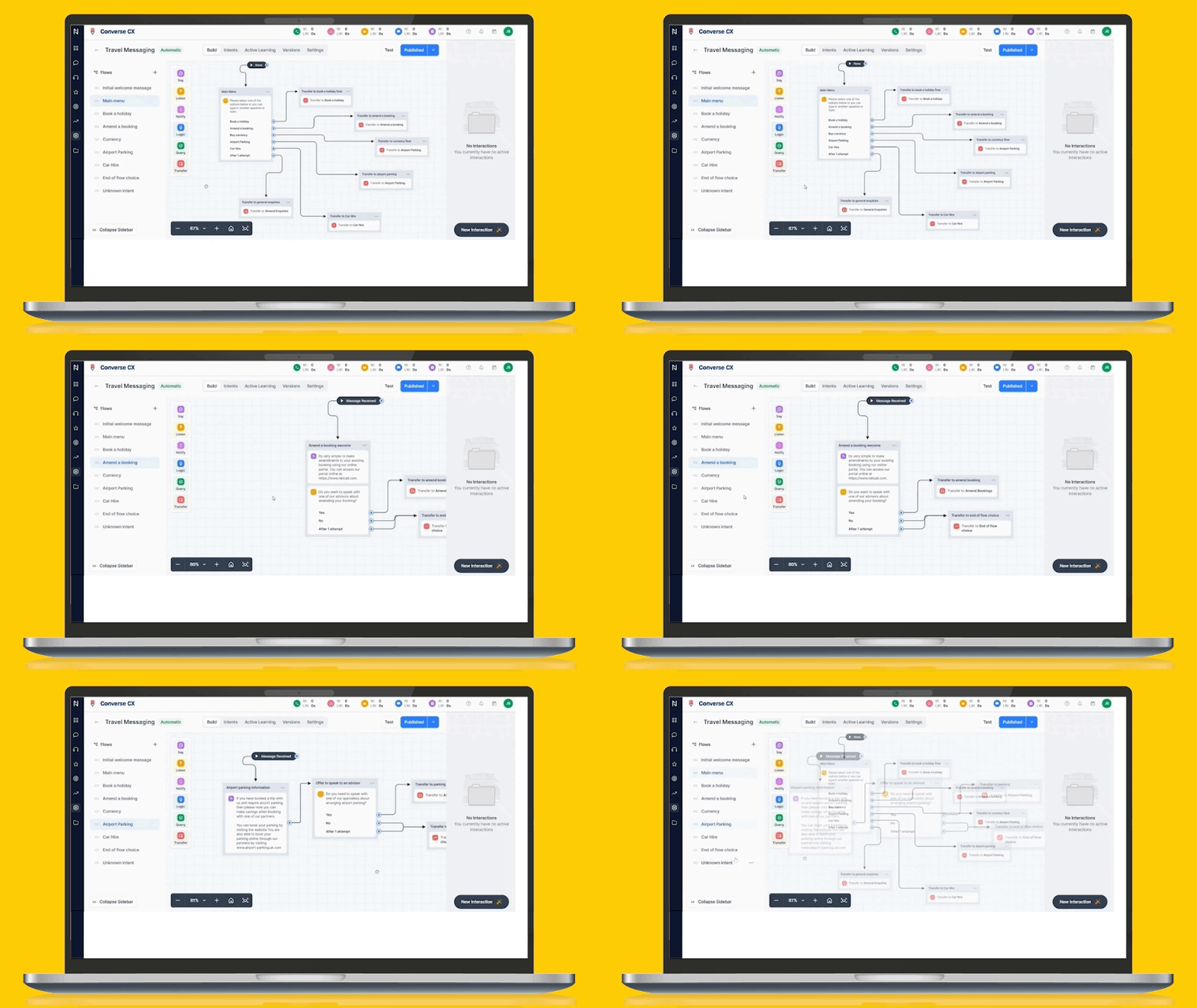
Image Source: netcall.com
Launched on 28 January 2026 with Netcall’s Liberty Converse platform, the agent acts as a first-line support route before staff reach the IT service desk. It interprets requests, retrieves relevant information from internal systems and troubleshooting guidance, resolves common issues in real time, and directs staff to the right support channel when needed.
For queries that still require IT input, the system can automatically raise a pre-populated service ticket with the correct categorisation and context. The trust says 41% of IT queries are now handled through self-service and AI agents, helping reduce pressure on phone lines and freeing IT teams to focus on more complex issues.
Key Features:
Reduced call volume: IT help desk calls fell by 28% after the AI agent was introduced, easing pressure on the service desk.
Routine query resolution: The agent handles common IT issues in real time using internal systems and troubleshooting guidance.
Automated ticket creation: When escalation is needed, the system raises a pre-populated service ticket with categorisation and context already included.
Continuous improvement: The trust analyses live staff interactions to refine accuracy, expand coverage, and improve the user experience.
Next phase: Rotherham is now looking at out-of-hours support, where the agent could resolve or redirect non-urgent requests so only priority incidents reach on-call teams.
Implications for the Health System and Clinicians: For practice managers and health service leaders, Rotherham shows that healthcare AI does not need to sit directly in the consultation room to deliver operational value. Some of the fastest returns may come from applying AI to internal bottlenecks that quietly drain staff capacity every day.
Routine IT support is a high-volume, low-complexity demand. The caveat is that call reduction is not the whole story. The next questions are whether staff satisfaction, resolution quality, escalation safety, and total cost hold up as the agent expands into out-of-hours support. Still, this is a clean example of agentic AI being used for real operational work rather than another chatbot.
UK Study Finds Patients Are Turning to AI Chatbots Before Their GP
A new study from King’s College London has found that AI chatbots are already changing how people access healthcare.
The survey of 2,093 UK adults found that 15% have used AI chatbots for health advice instead of contacting a GP or other NHS service. 1 in 10 have used AI for mental health therapy or wellbeing support instead of seeing a trained professional.
The main reasons were convenience (46%), curiosity (45%), uncertainty about whether the concern was serious enough for a GP (39%), and NHS waiting times (25%).
Among those using AI for health advice, 20% said the AI had not encouraged them to seek professional advice, while 21% said they had decided against seeking healthcare because of something a chatbot said.
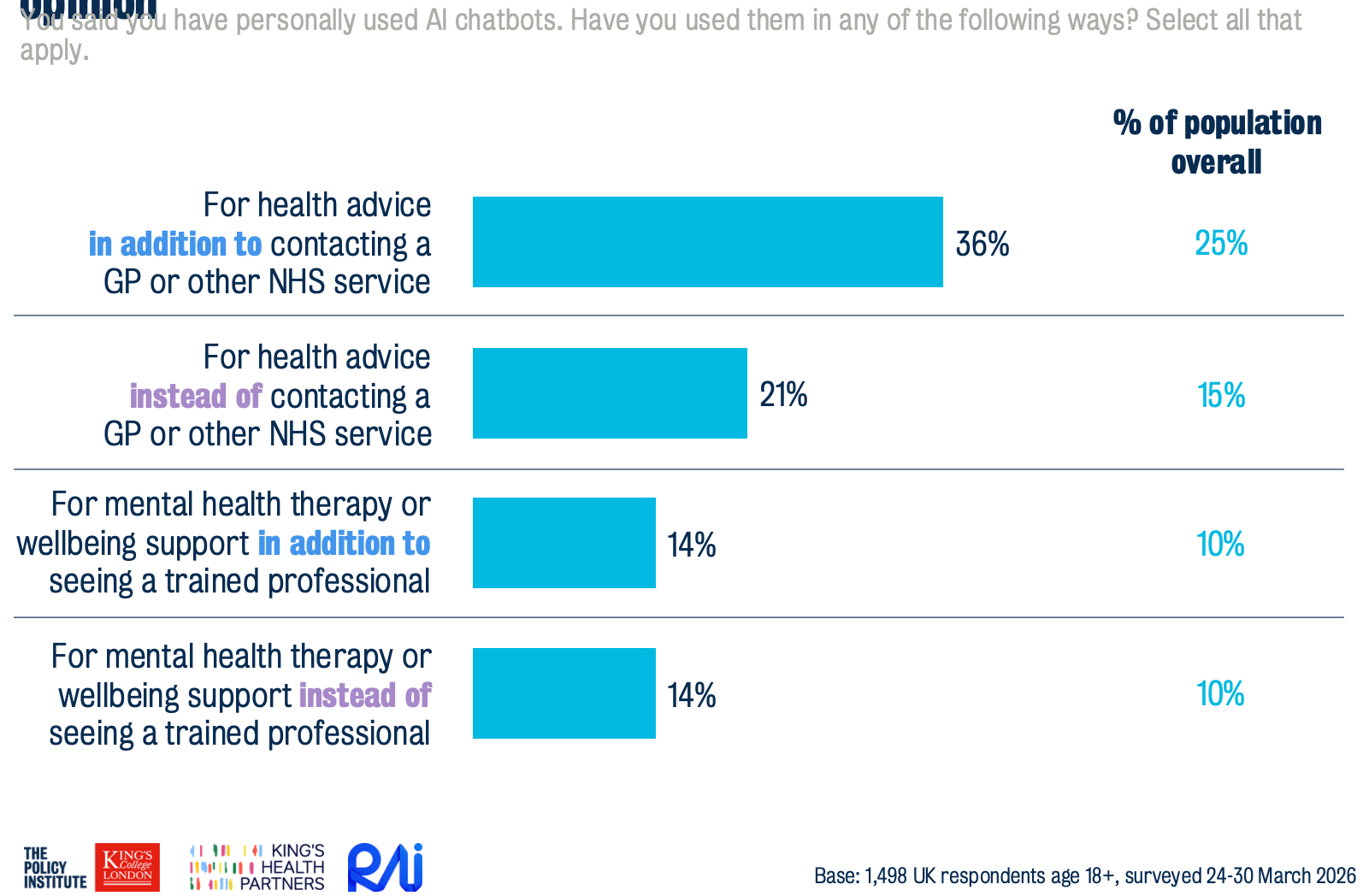
Image Source: kcl.ac.uk
Key Findings:
AI is already substituting for some first-contact care: 15% used AI chatbots for health advice instead of contacting a GP or other NHS service.
Mental health use is emerging: 10% used AI for mental health therapy or wellbeing support instead of seeing a trained professional.
Access pressure is a driver: Convenience, curiosity, symptom uncertainty, and NHS waiting times were the most common reasons for using AI.
Some patients are being steered away from care: 21% decided against seeking professional advice because of something a chatbot said.
Public trust remains divided: 37% support AI being used in NHS clinical decision-making, while 38% oppose it, with women and younger adults more cautious.
Implications for Healthcare Systems:
Patients are already adding AI to the care pathway themselves, often before they speak to a clinician. In general practice, the risk is delayed care, AI-generated advice entering consultations, or patients assuming a chatbot can safely triage symptoms that need proper clinical assessment. For practice managers and clinical leads, this points to the need for clear patient messaging, safer signposting, and staff awareness that AI may already be shaping the consultation before the patient walks in.
Read the full study here.
4. Vitals – Quick Bytes
Health NZ moves AI breast screening from scoping to procurement
Previously, we covered Health New Zealand’s early scoping of AI support for BreastScreen Aotearoa. That work has now moved a step closer to implementation, with a new national tender for AI-supported mammogram reading and breast density reporting. Rather than replacing radiologists, the proposed system would sit inside the existing double-reading process, taking on one of the two mammogram reads while clinicians remain responsible for diagnosis and follow-ups. Validation is expected to begin from July 2026, including testing across Māori, Pacific and Asian mammogram datasets, before comparison with radiologist reading in a prospective trial. With screening demand rising, the real test will be safe validation, workflow integration, and equitable performance.
Australian survey finds patients may accept AI summaries, if clinicians stay in the loop
A mixed-methods Australian survey of 275 consumers found cautious support for AI-generated consultation summaries. Participants saw potential for AI to save time, improve access, and make summaries easier to read, but remained concerned about accuracy and data use. In a scenario task, they preferred the AI-generated summary over a clinician-written version for capturing key issues, empathy, and which summary they would prefer to receive. The trust condition was clear: 88% said they would be more comfortable if a doctor reviewed AI-generated summaries before sharing them, and nearly 91% said clinicians should remain responsible for accuracy. For practices, the lesson is simple: AI-assisted communication may be acceptable to patients when it is useful, clear, and visibly supervised.
We’d love to hear your thoughts, so join the conversation by leaving a comment below:

Stay tuned for more insights in the next edition of The Pulse.
Have a great day & see you in two weeks!
Your Hendrix Health Team