

1. Triage – Your Fortnightly Rundown
Hi Pulse Readers - this week, we’re diving into:
how a Sydney hospital is testing AI voice interviews to assess patients before surgery,
what a 2,385-patient RCT shows about speeding autoimmune diagnosis after a positive ANA,
and how to pull Medtech appointments into Heidi, then push notes back to the record.
2. Case Study – Your Fortnightly Practical
Video Source: Streamlining Clinical Documentation: Medtech Evolution & Heidi
Taking a Consult from Medtech Appointment Book to Patient Record
Case Presentation: Dr Harry has been asking Heidi Evidence to review his recent consultations against the GP curriculum.
However, before each consult, he copies the latest patient assessment and medications from Medtech Evolution into Heidi. Afterwards, he pastes the note back into Medtech and splits it between the record’s fields by hand. Every paste takes time, and is another risk of putting something in the wrong place.
His practice has just integrated Heidi with Medtech. He wonders whether Heidi can now bring each patient in from his appointment book, and send the reviewed note straight back to their record in the PMS.
Approach: Heidi brings in the day’s appointments and patient context from Medtech, then push the reviewed note back to the right fields.
Start from your Medtech appointment book
With your appointment book open in Medtech, Heidi pulls it through, so today’s patients are listed in Heidi.
Note: The integration needs a Practice or Enterprise plan. Your practice first authorises access with its Medtech facility ID, then each clinician connects under Settings > Connectors > Medtech.
Check the context Heidi has brought across
Before you see each patient, Heidi pre-fills their context from Medtech, such as past medical history and current medications. The more detail recorded in Medtech, the more Heidi can pull through. As always, you can add to it by typing, dictating or uploading a PDF. A patient you book into Medtech during the day appears in Heidi too. Open the patient’s appointment to start a session linked to their Medtech record.
Set your template to the right fields in Medtech
Open your template from the template library, where Heidi’s ready-made templates sit alongside your own. You can ask for changes in plain language in the builder’s toolbar, such as bullet points, bold headings or a patient summary at the top. For the integration, set each section of your template to Medtech’s Subjective or Objective narrative fields. This means that every note from that template lands in the right field when you push. This setting sits in the Structure tab, which tells Heidi where each piece of information goes. If that looks daunting, the Example tab shows the same template as a sample note that you can review and edit.
Review the note, then push it to Medtech
Back in the session, your template turns the transcript into the note, ready for the fields you set. When the note is finalised, select Push to Medtech at the top of the note, and it goes into the patient’s Medtech record.
Important: Notes can be pushed to Medtech once per session, so review the whole note first. You remain responsible for what goes into the record.
Outcomes: Instead of manually copying and pasting history into Heidi and notes back into Medtech, Dr Harry now has his patients and their context waiting in Heidi, and a reviewed note that reaches the right fields of the record in one push.
There are now fewer chances to paste things into the wrong place. Dr Harry gets to focus more of his time in between consults on clinical tasks, such as reviewing the patients’ inbox before they arrive. Nurses can also work the same way from their own Medtech appointment books.
Disclaimer: Hendrix Health is the official New Zealand partner for Heidi Health.
3. The Pulse - Your Fortnightly Update
Sydney’s Royal North Shore Hospital Tests AI Voice Interviews to Assess Patients Before Surgery
Royal North Shore Hospital (RNSH) in Sydney is testing Pathways, an Australian start-up’s AI that lets patients complete much of their pre-surgery assessment, the health and risk check before an operation, by voice rather than forms. Reported on 5 November, the testing is supported by an A$100,000 local health district grant.
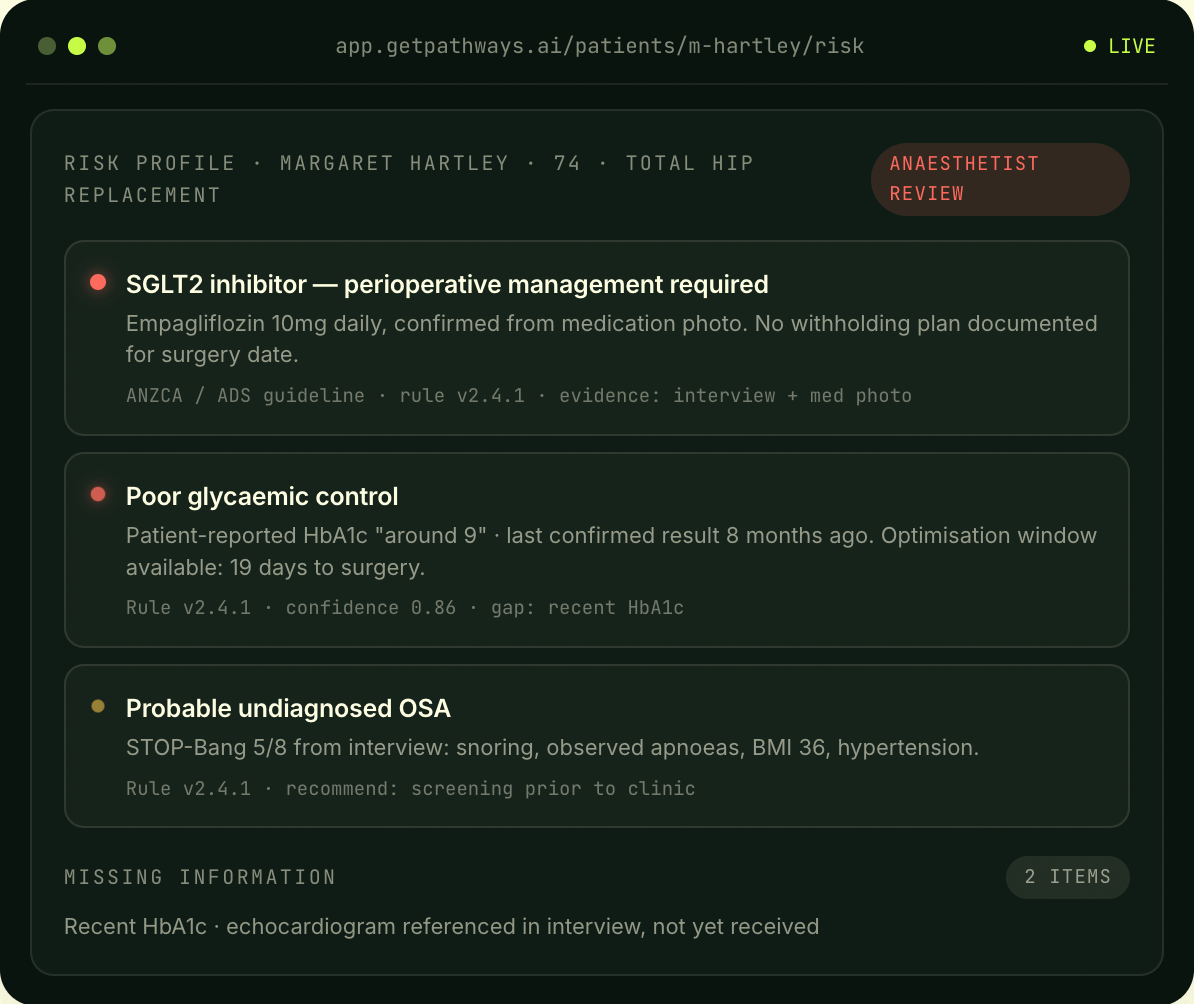
Image Source: getpathways.ai
Once a surgical referral is accepted, patients needing assessment get a text message linking to a voice conversation with an AI. With consent, they answer questions on 12 areas of health and history, and photograph their medicines. The answers are checked for risks such as heart problems, diabetes, sleep apnoea and frailty, and the system recommends the next step: an anaesthetist review, a clinic visit, a phone review, or nothing further. An anaesthetist makes the final call.
Patients tend to repeat the same history to 3 or 4 staff, and the company estimates this admin takes around 30 to 35 minutes of nursing time per patient. Dr Andrew Marks, the anaesthetist leading RNSH’s use of Pathways, says this stage “is where surgical risk is either caught or missed.”
Key Features:
Fixed rules set the flags: The AI organises the answers, while risk flags come from fixed clinical rules that the hospital can audit, so the same answers always get the same result. Any unclear answers go to a clinician.
Built for harder-to-reach patients: A voice call might better suit older patients, people with visual impairment and non-native English speakers. The company also says that its AI agent speaks more than 80 languages.
Data kept in Australia: Patient data never leaves Australia, and the company’s AI suppliers receive no identifying details.
No large IT project: It works without connecting to the hospital’s patient record system.
Implications for the Health System and Clinicians: This is AI taking on surgical paperwork while the anaesthetist keeps the clinical decision. For hospitals in Aotearoa, catching risk earlier and sparing low-risk patients a clinic visit could free clinical time and reduce avoidable cancellations on the day of surgery. The caveat is that RNSH is still validating the tool, and no accuracy, completion or cancellation data has yet been published. The jury is still out on whether older patients and non-native English speakers will complete a voice interview as reliably as a nurse-led assessment.
Read the full story here.
Speeding Autoimmune Diagnosis After a Positive ANA: What a 2,385-Patient RCT Shows
A positive antinuclear antibody (ANA) blood test can signal autoimmune disease, but it is often ordered for vague symptoms and can be positive in healthy people, so deciding whom to refer to a rheumatologist is hard. A randomised trial in NEJM AI tested whether AURA, a risk score in the electronic health record, could speed up diagnosis.
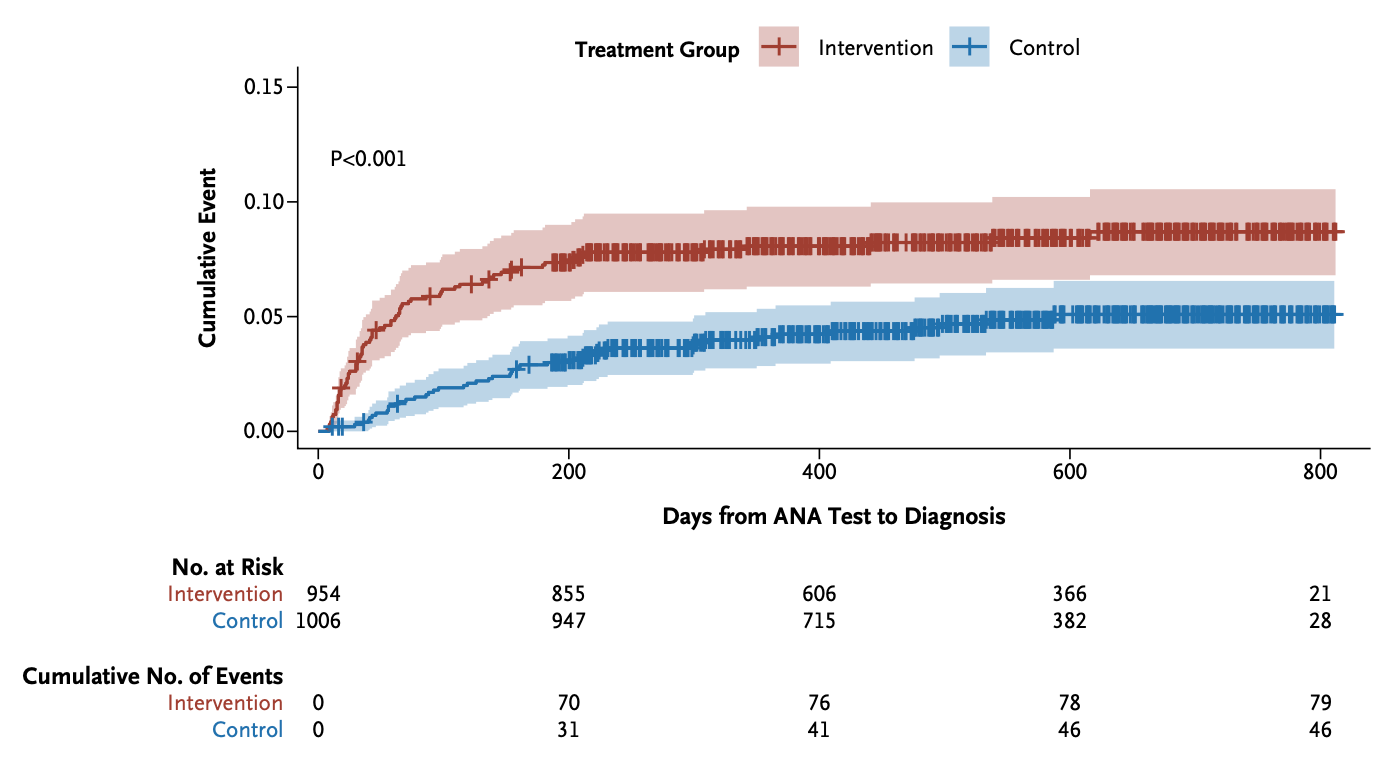
Image Source: New England Journal of Medicine
At Vanderbilt in Tennessee, 2,385 adults with a first positive ANA were randomly split into two groups over 2 years, and 1,960 were analysed. The system scored each person’s 10-year risk of autoimmune disease, such as lupus, from details like age/sex, ANA level, another autoantibody, and recorded symptoms such as joint pain and rash. For AURA-group patients at high risk (20% or more), the team messaged the ordering clinician and offered a fast-track rheumatology appointment. In usual care, clinicians were never told the score and referred patients as normal.
Key Findings:
Diagnosed sooner: 79 people in the AURA group were diagnosed, against 46 with usual care, nearly twice the rate (hazard ratio 1.9; P<0.001), and half of them were diagnosed within 43 days of the test, against 138.
More seen early: Within 6 months, 32% of the AURA group saw a rheumatologist, against 17%, and 203 of 270 high-risk patients took up the fast-track.
The score held up: In usual care, it still ranked people later diagnosed above others 79% of the time, and the speed-up was significant only in the top quarter of scores, the group offered the fast-track (P=0.002).
Hit rate not clearly higher: Though nearly twice as many saw a rheumatologist within 6 months, a larger share were diagnosed (23% against 16%), a gap that could be chance (P=0.07).
Implications for Healthcare Systems:
AURA is a simple, transparent score that clinicians can check. It also matched more complex AI in testing, and few prediction models pass a randomised test in routine care. Primary care ordered the most ANA tests (36%), a familiar picture for NZ GPs. The caveat is that the score and fast-track came as a package, so the trial cannot tell how much each helped separately. It also ran at one US centre with few Asian or Hispanic patients, and measured time to diagnosis rather than health outcomes.
Read the full study here.
4. Vitals – Quick Bytes
AI Eye Screening With Instant Results Nearly Doubles Specialist Follow-Up in Tanzanian RCT
A randomised controlled trial in The Lancet Global Health enrolled 2,378 adults having diabetic eye screening at 24 Tanzanian hospitals. Half had their retinal photos read by AI and left with the result and face-to-face counselling; the rest got their human-graded result and advice by phone or text weeks later. Among the 904 who truly needed an eye specialist, 35.9% of the AI group reached the eye clinic within 8 weeks, against 18.2%. The AI caught more cases needing referral than the human graders (91.6% against 85.0%) but raised more false alarms. Tanzania’s Ministry of Health has since committed to AI-supported screening in multiple regions.NHS MRI Services Using AI Acceleration Carry Out 14% More Scans on Average
The NHS in England has installed AI acceleration software in 54% of its compatible MRI scanners. The software builds a high-quality image from less data, so scans are shorter and machines fit in more patients a day. Services using it carry out 14% more scans on average while maintaining image quality, the government says. Every NHS trust will be offered the upgrade by 2029; a full rollout would add up to 162,000 checks a year. In Aotearoa, Health NZ’s national radiology platform tender, which includes an imaging AI component, closes on 19 November. The caveats: these NHS figures are government-reported averages, with no controlled comparison, and the Royal College of Radiologists says the workforce is as vital as the equipment. (gov.uk, gets.govt.nz)
We’d love to hear your thoughts, so join the conversation by leaving a comment below:

Stay tuned for more insights in the next edition of The Pulse.
Have a great day & see you in two weeks!
Your Hendrix Health Team