

1. Triage – Your Fortnightly Rundown
Hi Pulse Readers - this week, we’re diving into:
how a Singapore hospital uses AI to screen every pneumonia patient for unneeded antibiotics,
what a 284,002-woman study reveals about cutting colposcopy referrals with AI-assisted cytology,
and how to audit your own recent consultations against the GP curriculum with Heidi Evidence.
2. Case Study – Your Fortnightly Practical
Video Source: Dr Karl Cole (MB ChB, FRNZCGP), Supercharge your GP Practice with Heidi Webinar in collaboration with Health Accelerator and Collaborative Aotearoa
Auditing Your Own Consultations with Heidi Evidence
Case Presentation: Previously, Dr Harry checked an imaging referral against Health NZ’s national criteria with Heidi Evidence.
This fortnight, he is preparing for his annual conversation under the RNZCGP’s Te Whanake CPD programme. Until now, he has planned his learning almost ad hoc, based on memory and bias: maybe asthma this year.
Since he started adult ADHD assessments, his caseload has shifted. He asks himself whether he is seeing the same mix as an average GP, whether he is becoming biased towards one kind of practice, and whether he is out of touch somewhere, for example in talking about statins with patients after a heart attack.
He wonders whether Heidi can look across all his consultations and tell him what he could work on.
Approach: Point Heidi Evidence at the College’s curriculum, then ask it to review all your recent consultations.
Put the reference documents in one collection
Download the College’s Curriculum for General Practice, plus any peer review guidance you use. In Evidence, open Library, upload them under Documents, then add them to a New Collection, for example “Peer review audit”. Nurses and allied health professionals can use their own regulator’s or professional body’s standards instead.
Open a standalone Evidence conversation with only that new collection switched on
Go to Evidence and start a standalone conversation, not linked to a patient. Click the sources button and switch from last fortnight’s imaging criteria to your new collection only.
Ask for a review of all your available consultations
Example prompt: “Review all my available consultations from the last two weeks against the GP curriculum. There is no need to compliment me. Suggest up to three priorities I could work on, with the rationale and sources.”
Note: A prompt is the instruction you give an artificial intelligence to tell it what to do. The clearer and more specific the instruction, the better the output.
If the first answer only compliments you, refine the prompt. And keep it to three priorities, because a full critique runs long.
Read the output critically
Expect it to discuss individual cases, what could have been done better, and whether care met the guidelines, for example after a hip fracture, in safety netting or in explicit red flagging. It cannot see everything: anything recorded only in your PMS, such as a cardiovascular risk assessment, can be flagged as missing. Check each point against the full record before you act on it.
Use the findings to plan your year
Turn them into reflections, and plan your CME and peer review for the year around them. Repeat the review periodically.
Important: The review is driven by you, on your own consultations, for your own reflection. Clinical judgement and accountability stay with you.
Outcomes: Until now, few GPs could look at their last 100 cases in detail. Dr Harry now has priorities for CME planning drawn from two weeks of his own consultations. The patterns the review found, and the questions it raised, surprised him.
The review gives feedback on the cases that tick past and are easily forgotten, and raises the quality of his own internal audits. Because he drives it himself, with the full context only he has, the review stays in professional hands, resulting in better care for his patients and their whānau.
Disclaimer: Hendrix Health is the official New Zealand partner for Heidi Health.
3. The Pulse - Your Fortnightly Update
Singapore General Hospital Uses AI to Screen Every Pneumonia Patient for Unneeded Antibiotics
Singapore General Hospital (SGH) won an international patient safety award on 21 October for AI2D, an AI tool that helps clinicians decide whether patients with pneumonia or other lower respiratory tract infections (LRTIs) need antibiotics.

Image Source: news-medical.net
In use since 2024, AI2D reads data already in the electronic record, including chest X-ray reports, vital signs and blood results, and flags patients whose infection is unlikely to be bacterial. The hospital’s antibiotic stewardship team reviews those cases and advises the treating clinician, who makes the final call.
About half of SGH’s inpatients are on antibiotics at any one time. Tests take 2 to 3 days to show whether an infection is bacterial, so clinicians often start antibiotics while they wait.
Key Features:
Every case screened: With 10 to 12 staff for the whole hospital, the stewardship team could review only around 30% of LRTI cases. AI2D now checks every case first, and the team spends its time on the roughly 30% it flags.
A randomised pilot: In 2024, SGH randomly split the 205 patients AI2D flagged: half got a stewardship review, half usual care. Within 2 days, antibiotics were stopped for 30 of 102 reviewed patients, against 8 of 103 in usual care, and median hospital stay was a day shorter (5 days against 6).
No sign of harm: Readmissions within 30 days and escalations of care were no different between the groups, and clinicians accepted 73% of the team’s advice to stop antibiotics.
Speed and accuracy: AI2D analyses a case in under a second, where a manual review takes about 20 minutes, and is 90% accurate at judging whether antibiotics are needed.
Implications for the Health System and Clinicians: SGH’s medical board chairman calls AI2D a “force multiplier” - a small team can now concentrate on the patients most likely to come off antibiotics. For Aotearoa, where antibiotic resistance and stretched hospital teams are familiar problems, the model is worth watching. The caveat is that the evidence is from a six-month pilot of 205 patients at one hospital, not yet peer reviewed. A separate trial of prescribers using AI2D themselves has yet to report. Others cautioned that a tool trained on hospital patients may not suit general practice or other populations.
Read the full story here.
AI-Assisted Cytology Cuts Colposcopy Referrals in Cervical Screening: a 284,002-Woman Study
Cervical screening must decide who goes on to colposcopy, a specialist cervix examination. A retrospective study from Wuhan, China, compared nine strategies for making that call, using an HPV test, an AI-assisted cervical cytology (checking cells from a smear), or both. It drew on 284,002 women aged 35 to 64 screened through 331 primary care clinics from 2020 to 2022.
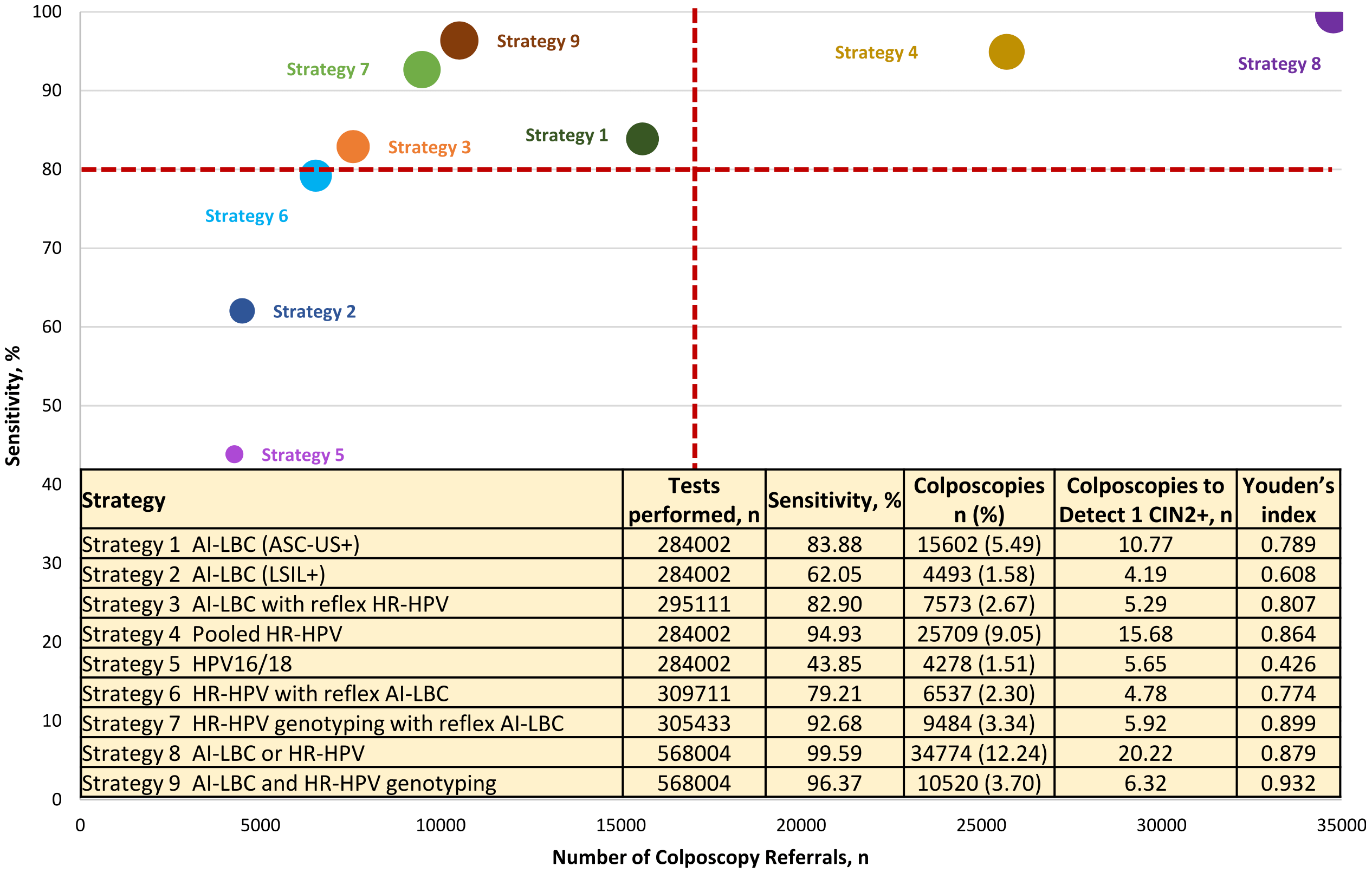
Image Source: Nature
Every woman had both tests on one sample - 1. an HPV test that flags the highest-risk types, 16 and 18; and 2. an AI scan of her cells, checked by laboratory staff. Both results let the team apply each strategy to every woman and count the colposcopy referrals it would have made and the pre-cancers (CIN2 or worse) it would have caught. Biopsies and six months of hospital records showed who had pre-cancer, with statistics estimating cases missed among women never biopsied.
Key Findings:
HPV alone refers many: Sending every HPV-positive woman for colposcopy caught 94.93% of pre-cancers but referred 9.05% of all women, about 16 colposcopies for each pre-cancer found (15.68).
HPV first, AI to sort: Sending HPV 16 or 18 straight to colposcopy, and other HPV types only after an abnormal AI cell check, caught almost as many (92.68%) while referring 3.34%, about 6 colposcopies per pre-cancer found (5.92).
Both tests did best overall: Referring on the combined HPV and AI results caught 96.37%, slightly more than HPV alone, while referring 3.70% (about 6 colposcopies per pre-cancer, 6.32), though every woman needed both tests.
AI alone above past smears: Used on its own, the AI cell check caught 83.88% of pre-cancers, above the 75.51% that human-read smears of the same kind averaged in 40 earlier studies, though below HPV testing.
Implications for Healthcare Systems:
For NZ, the HPV-first route mirrors the pathway adopted here in 2023, where AI could take on the cytology step. However, the study looked back at past records from one city, did not compare AI with human experts reading the same slides, estimated pre-cancer status for women never biopsied, and did not weigh costs.
Read the full study here.
4. Vitals – Quick Bytes
MoleMap’s AI Linked to More Skin Cancers Found in Nurse-Led Checks Across 98,422 Patients
A real-world study at MoleMap, not yet peer reviewed, tested whether AI helps its nurses decide which skin spots to send to a dermatologist, who reviews the images remotely. In some New Zealand clinics, the AI, Kahu, showed nurses a cancer-risk score for each spot; other clinics in New Zealand and Australia worked without it. Of every 1,000 spots nurses sent on, dermatologists diagnosed 25.5 as skin cancer with AI, against 15.7 without. The gain held for all three main skin cancers and was largest for experienced nurses. Fewer biopsies or excisions were also recommended per cancer found. The caveats: clinics were not randomly assigned, diagnoses were not checked against biopsy results, and MoleMap, which owns the AI, co-funded the study, with its staff among the authors.Children’s National Uses AI to Call In Extra ED Staff Before Sick Children Leave Unseen
Since 2024, Children’s National Hospital in Washington, DC, has used AI to forecast crowding in its paediatric emergency department (ED). Hourly, it predicts how many children triaged as urgent or higher will leave in the next eight hours without being seen. If it predicts more than two, an alert prompts the hospital to call in extra clinicians from a pre-arranged surge team. The clinician who built it says waits on days with over 200 patients were more than 25% shorter in September 2026 than in September 2023 and 2024. A peer-reviewed study of 512,616 past visits found its forecasts accurate (AUROC 0.85, where 1 is perfect). The caveats: the 25% has no published method, and the study only tested forecasts on past visits.
We’d love to hear your thoughts, so join the conversation by leaving a comment below:

Stay tuned for more insights in the next edition of The Pulse.
Have a great day & see you in two weeks!
Your Hendrix Health Team